All of Philosophy Everywhere at Once

Max Noichl

Utrecht University

2024-05-14

Overview

  • Eet Smakelijk!
  • Sidequest from my other PhD-work.
  • Which is - agent-based modelling, social dynamics, philosophy of science &machine learning
  • Today: The Analytic-Continental Divide
    • Why are we doing this?
    • Getting data
    • Training a model.
    • Some thoughts on validation
    • Results

Why would one want to do such a thing?

  • What? - Computational History of Ideas, Computational Social Science of intellectual developments, Digital Literature Analysis
  • Because we can! - Data, sophisticated models, infrastructure.
  • Dissatisfaction with small-sample historiography, esp. about large patterns.
  • Democratization: More people should matter to the history of philosophy. Against Great Men Theory

Comp. History of Ideas: Some Tasks

  • Operationalization of terms of Art – Ideas, Schools, Denkrichtungen, traditions.
  • Reification, ‘Cashing in’ of metaphors: Fields, Divisions, Polarisation, Movements.
  • Spatial metaphorology lends itself to visualization: Modeling task.

The Analytic-Continental Divide

  • Division occurs at some point in the early-mid 20th century, details are contested, as is the degree to which it still matters.
  • Characterized by recurring invective e.g. Carnap – Heidegger, Ryle – Merleau-Ponty, Searle – Derrida, Nussbaum – Butler…
  • Still present in academic contexts – partially underlies the ‘science’ and ‘culture’ wars.
  • Improve earlier, citation-based work.

What is Analytic Philosophy?

  • Oriented towards logic, mathematics, empirical science.
  • Historical roots in logical positivism, British empiricism, American pragmatism.
  • Values clarity of argumentation, tends to see philosophy as a set of solvable problems. Professionalized.

One analytic Program: Wittgenstein

6.53 The right method of philosophy would be this: To say nothing except what can be said, i.e. the propositions of natural science, i.e. something that has nothing to do with philosophy; and then always, when someone else wished to say something metaphysical, to demonstrate to him that he had given no meaning to certain signs in his propositions. This method would be unsatisfying to the other—he would not have the feeling that we were teaching him philosophy—but it would be the only strictly correct method.

One analytic Program: Wiener Kreis

This method of logical analysis is what essentially distinguishes the new empiricism and positivism from the earlier one, which was more biologically-psychologically oriented. When someone claims: “There is no God”, “The primal foundation of the world is the unconscious” […] we don’t tell them: “What you say is false”; instead, we ask them: “What do you mean by your statements?” And then it turns out that there is a sharp boundary between two types of statements. To one group belong the statements made in empirical science; their meaning can be determined through logical analysis, more precisely: by reducing them to the simplest statements about empirically given things. The other statements, including the ones mentioned earlier, turn out to be completely meaningless if one takes them as the metaphysician means them.

What is Continental Philosophy?

  • Historically composed of structuralism, existentialism, phenomenology, and hermeneutics.
  • Affinity to psychoanalysis, critical theory, feminist theory, marxism & post-modernism.
  • Values political & societal engagement, historical analysis, artistic expression.

One Continental Program: Husserl

It belongs to what is taken for granted, prior to all scientific thought and all philosophical questioning, that the world is—always is in advance—and that every correction of an opinion, whether an experiential or other opinion, presupposes the already existing world, namely as a horizon of what in the given case is indubitably valid as existing. Objective science, too, asks questions only on the ground of the world’s existing in advance through prescientific life.

Another Continental Program: Foucault

Quite obviously, such an analysis does not belong to the history of ideas or of science: it is rather an inquiry whose aim is to rediscover on what basis knowledge and theory become possible; within what space of order knowledge was constituted; on the basis of what historical a priori, and in the element of what positivity, ideas could appear, sciences be established, experience be reflected in philosophies, rationalities be formed, only perhaps, to dissolve and vanish soon afterwards.

The Data

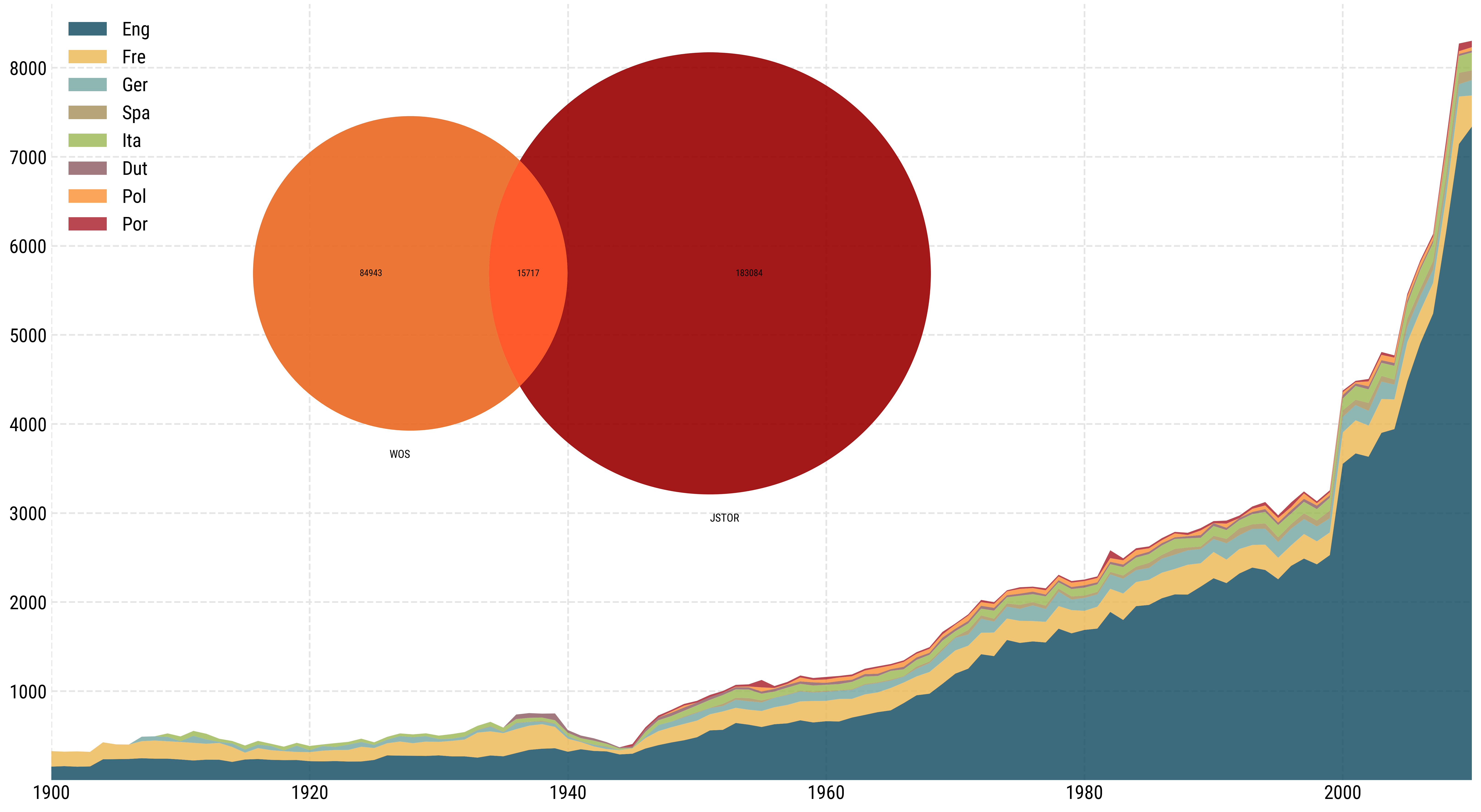
  • Large sample size: JStor + WOS (283,744 articles after filtering).
  • Refined by journal tags & PhilPapers journal list.
  • Time range: 1900-2021.
  • Interactive data-cleaning strategy.
  • Sample extended to include PhilPapers abstracts.

Language-Distribution

Model Requirements

  • Model of polarities.
  • Diachronic.
  • Multilingual.
  • Sophisticated language representation.

Training a custom language model

Nils Reimers and Iryna Gurevych “Making Monolingual Sentence Embeddings Multilingual Using Knowledge Distillation (October 2020)., Nils Reimers and Iryna Gurevych “Sentence-BERT: Sentence Embeddings Using Siamese BERT-Networks (August 2019).

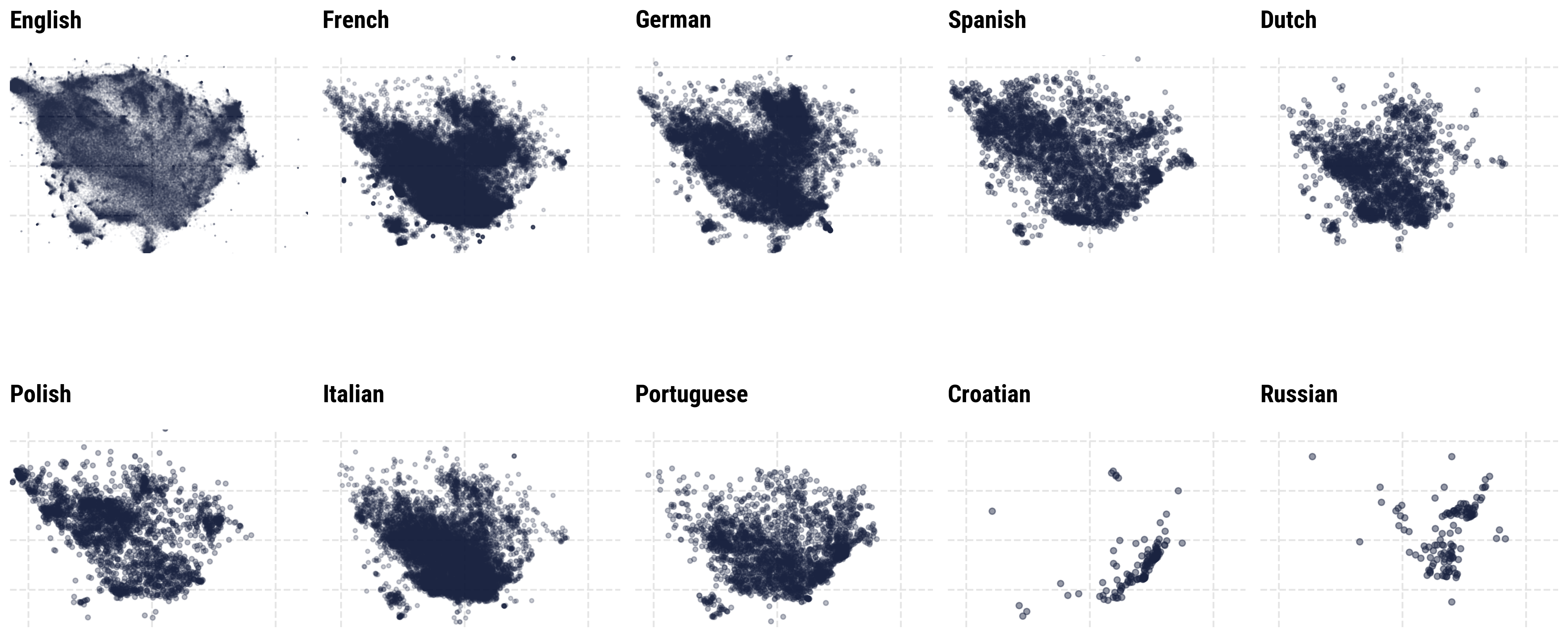
Validation: Languages

Validation - By Content

  • Validation of our model using triplet evaluation: Extract a sample from Stanford Encyclopedia-Texts and another subsequent sample, then select similar but distinct negative samples.
  • Model must identify which samples belong together.
  • Baseline model: Success rate of 0.86.
  • PhilroBERTa: Success rate of 0.92.
  • More challenging or specific tasks?

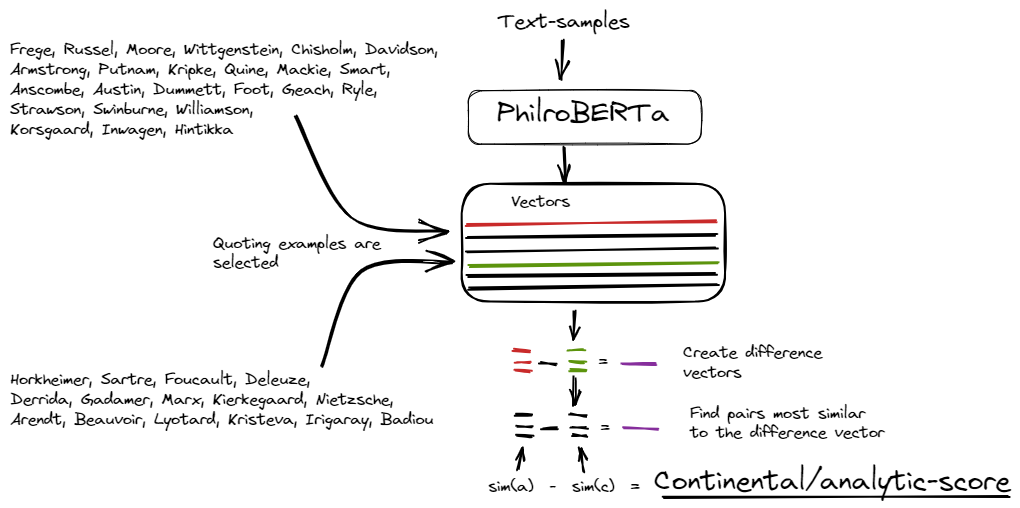
Building a Cont./Analyt.-score

Isaac Waller and Ashton Anderson “Community Embeddings Reveal Large-Scale Cultural Organization of Online Platforms,” arXiv:2010.00590 [Cs], October 2020.

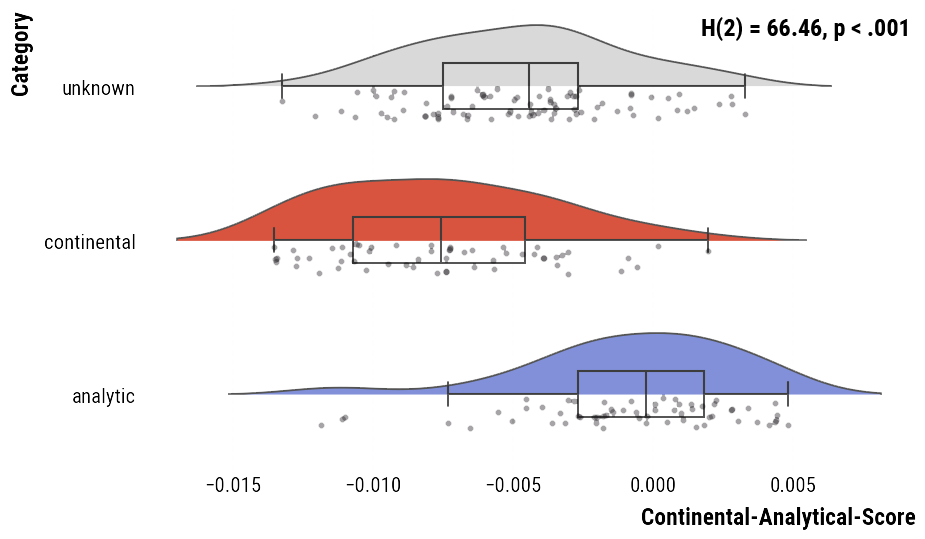
Evaluating our Score (WIP)

  • Using a web application where philosophers can give their assessment of the texts.
  • Options: Continental – Analytic – Uncertain – Do not understand (Language).
  • Results from the tool are compared with scores calculated by PhilroBERTa for consistency.
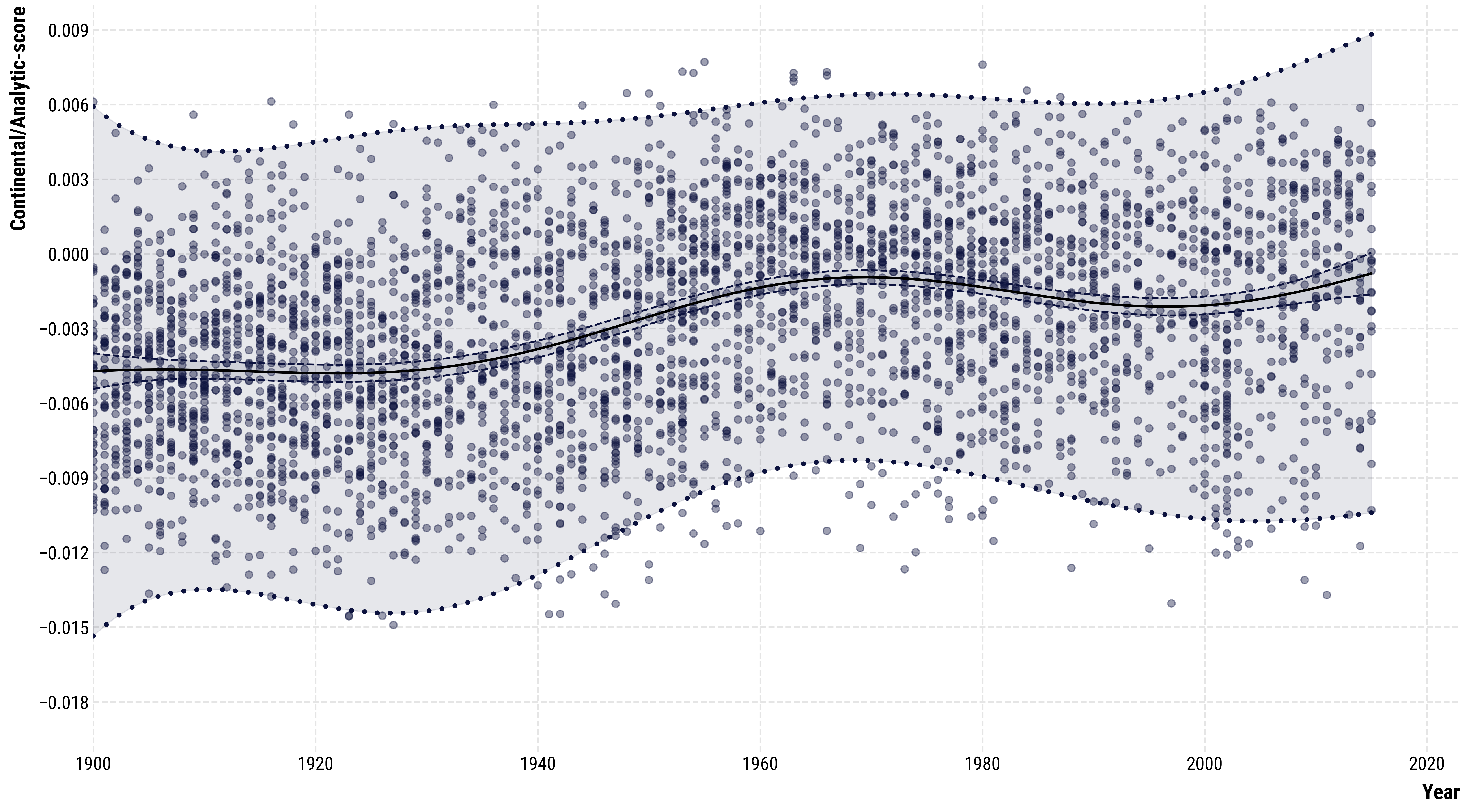
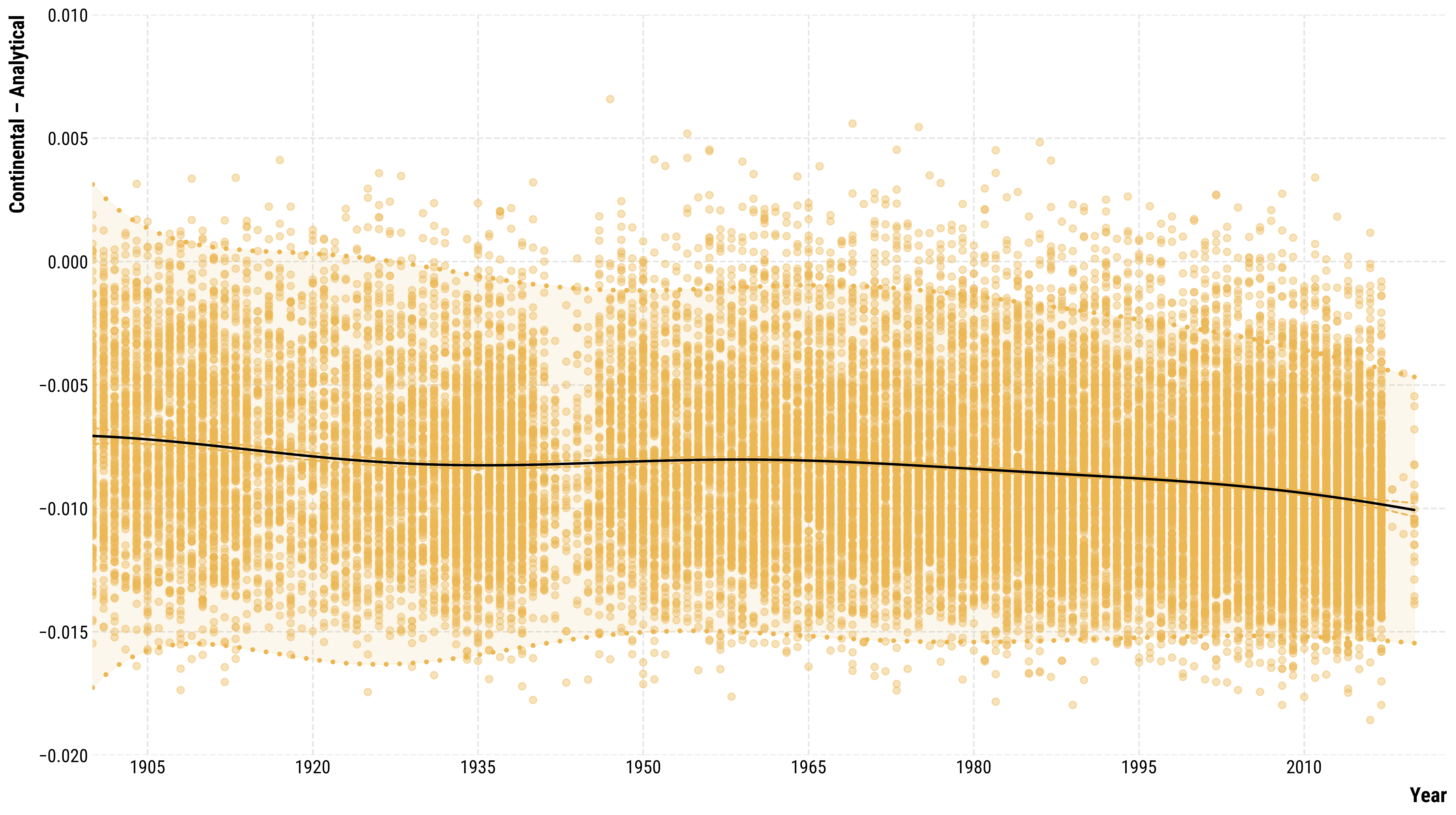
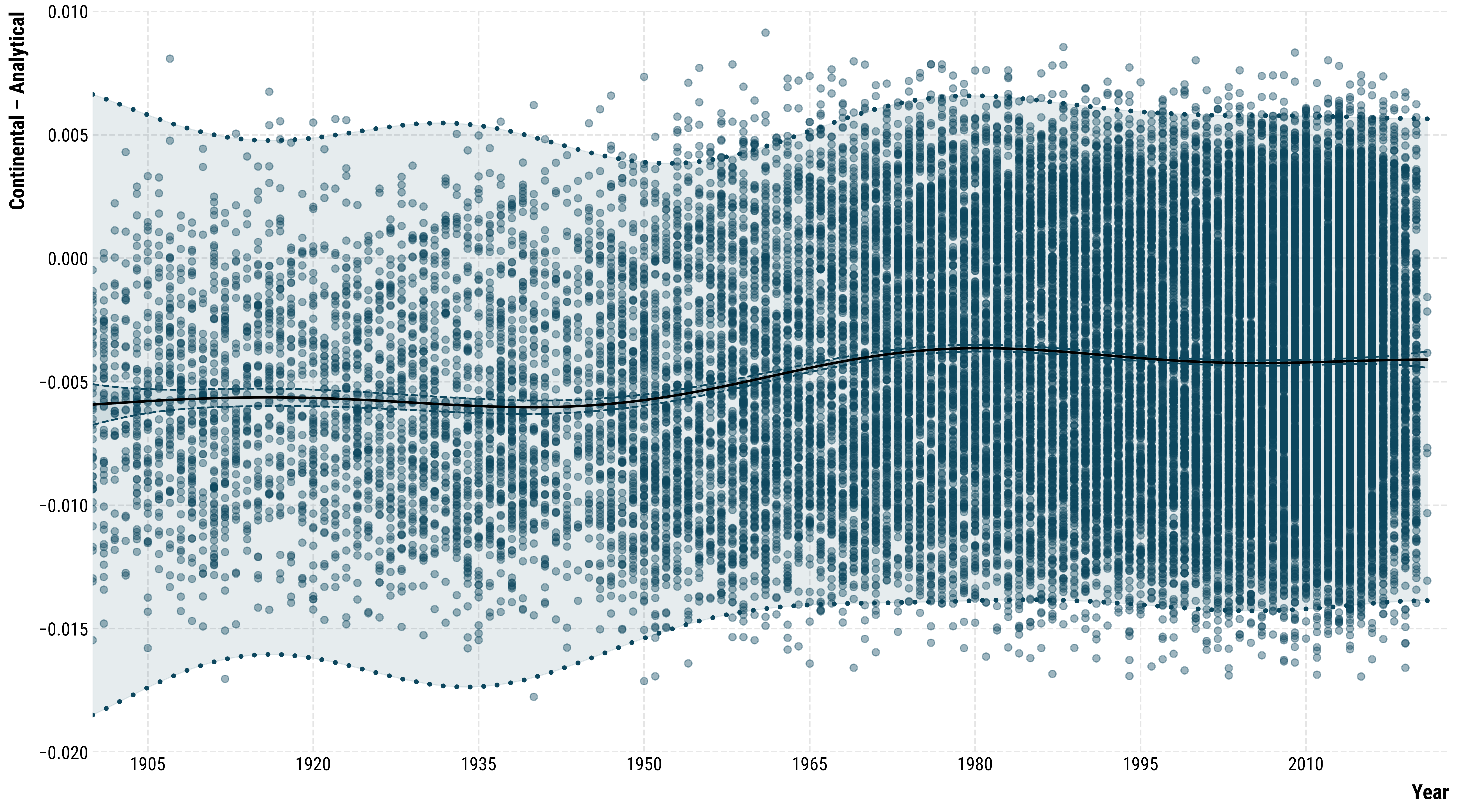
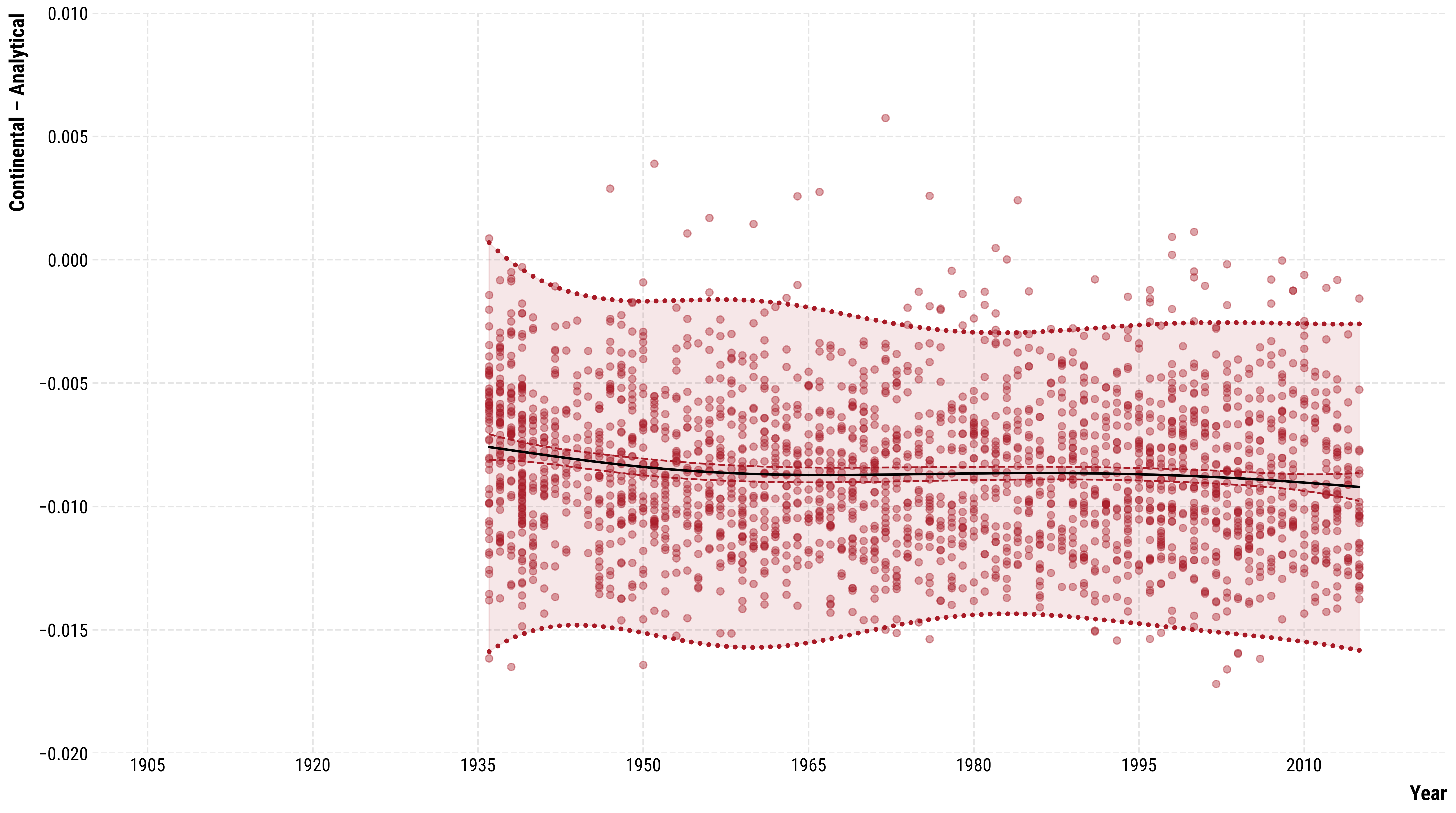
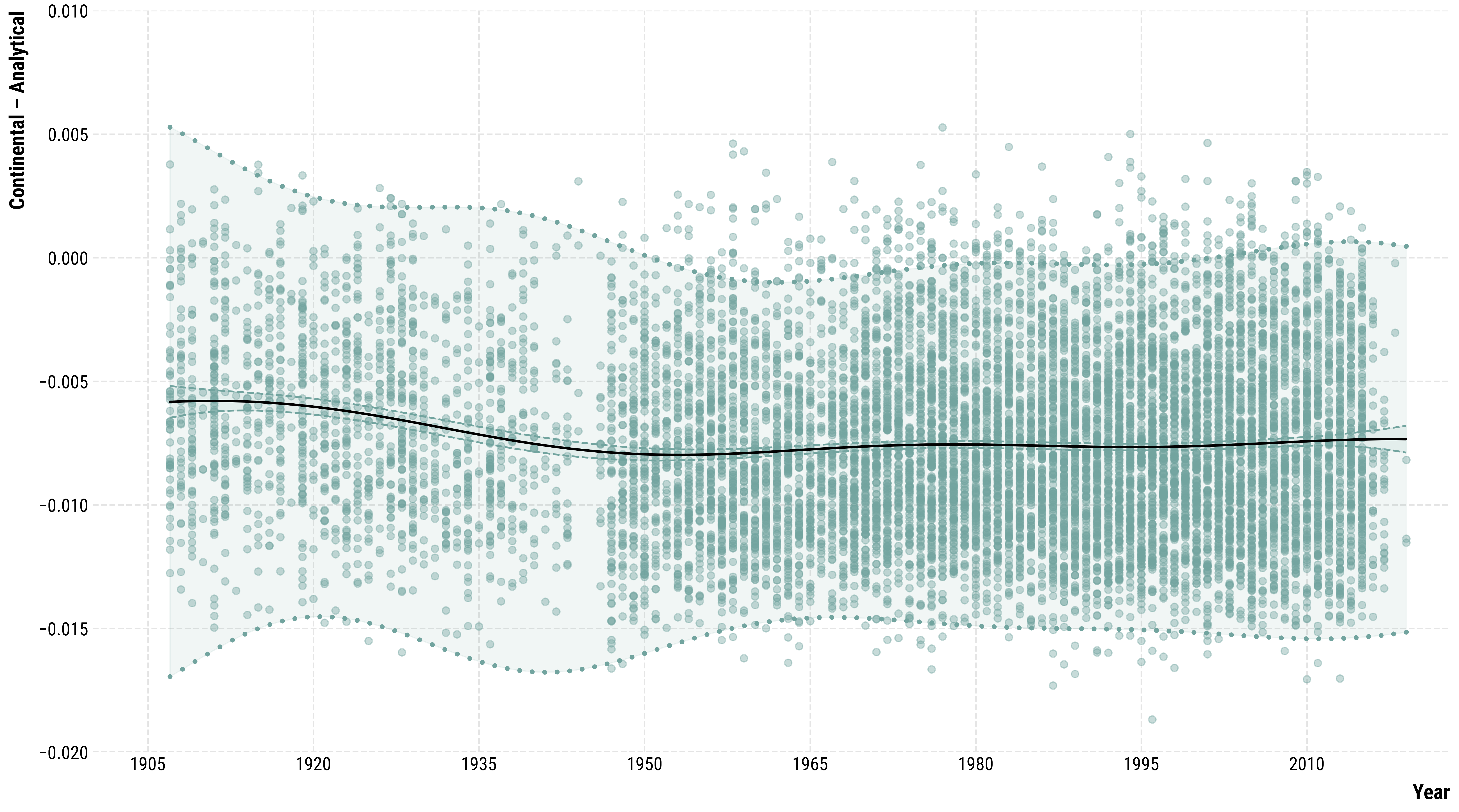
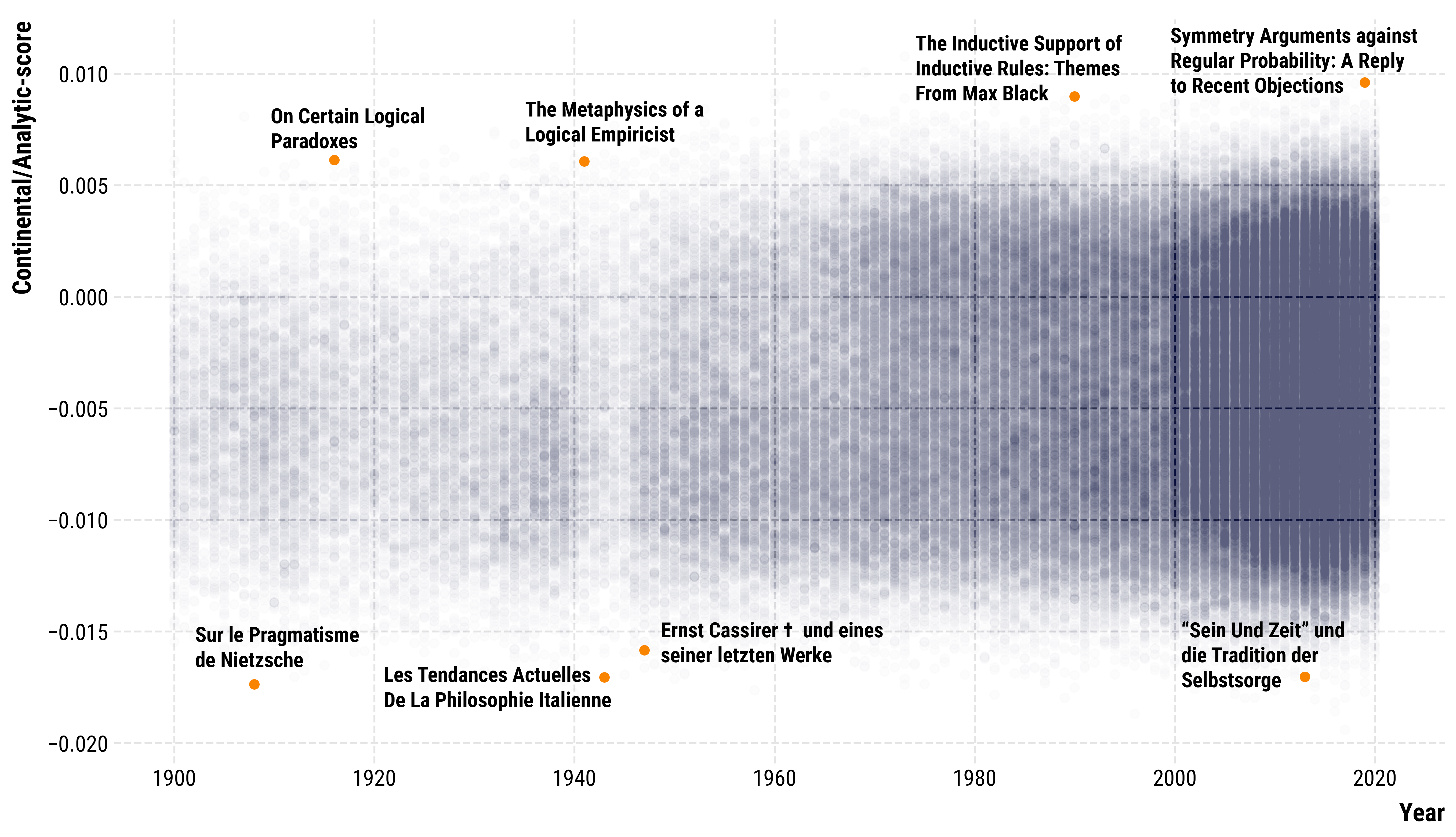
Continental-analytical scores over time
The Journal of Symbolic Logic
Synthese
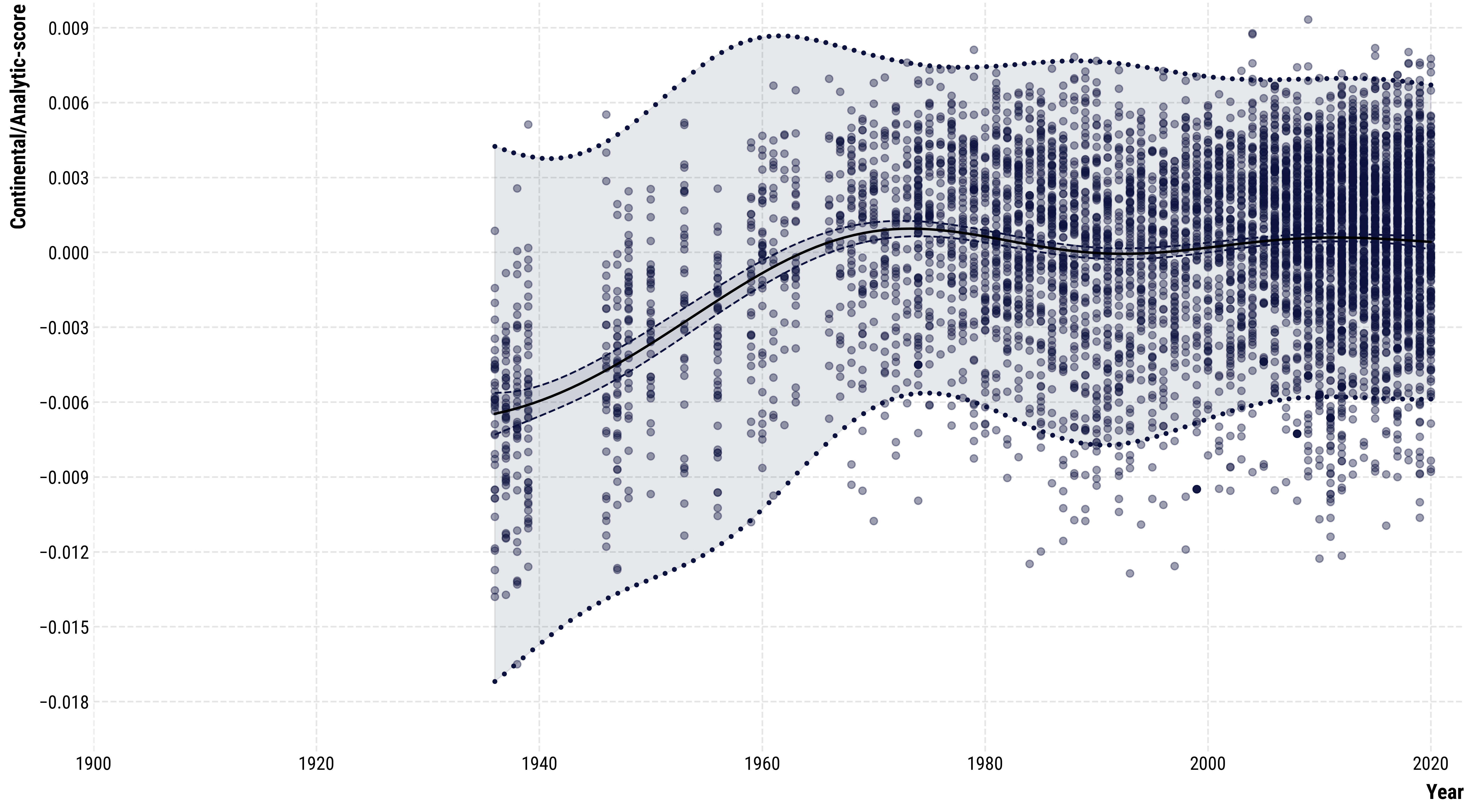
Joel Katzav “Analytic Philosophy, 1925–69: Emergence, Management and Nature,” British Journal for the History of Philosophy 26, no. 6 (2018): 1197–1221.

Philosophical Review

Jonathan Strassfeld “American Divide: The Making of Continental Philosophy,” Modern Intellectual History 17, no. 3 (September 2020): 833–66.

Revue de Métaphysique et de Morale
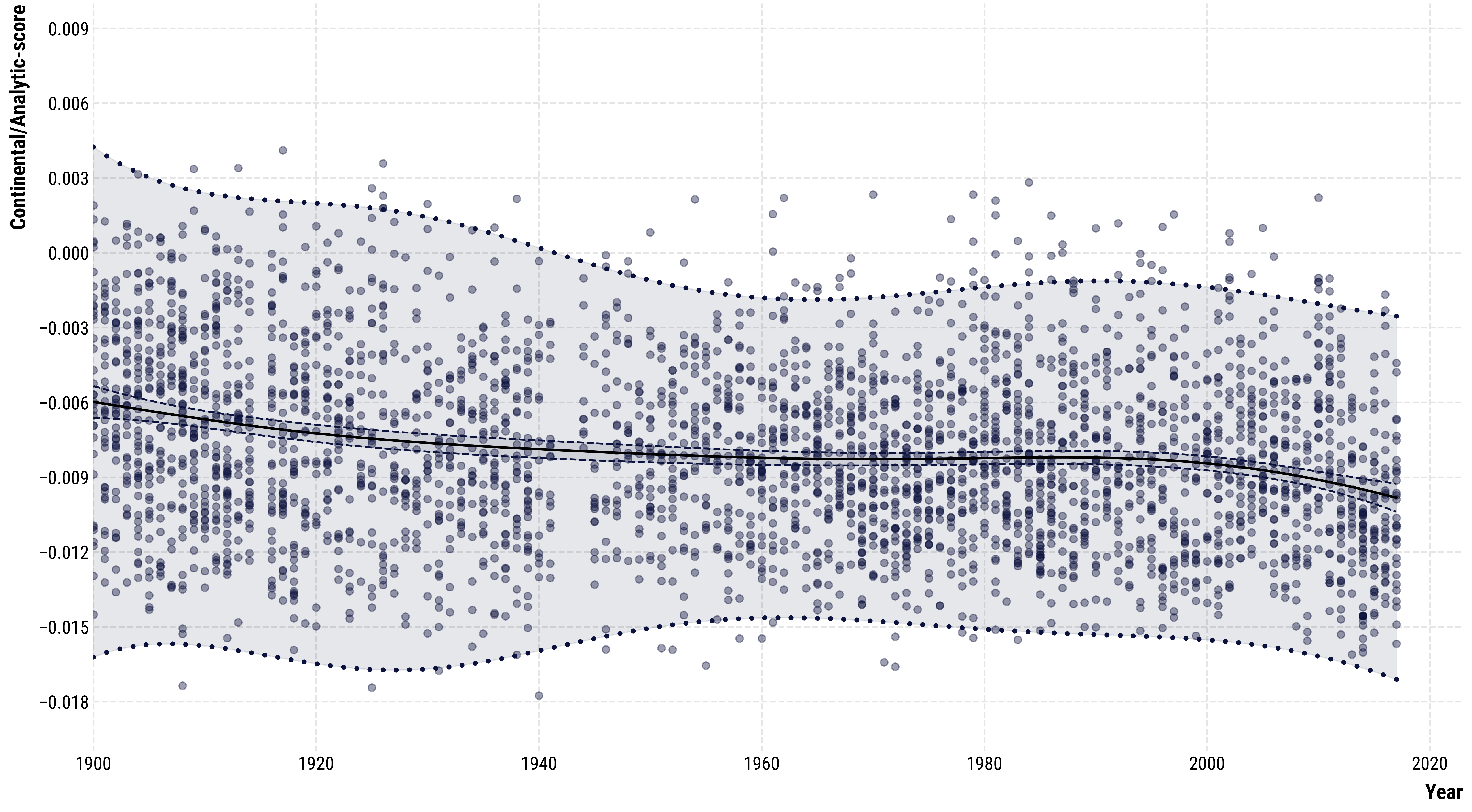
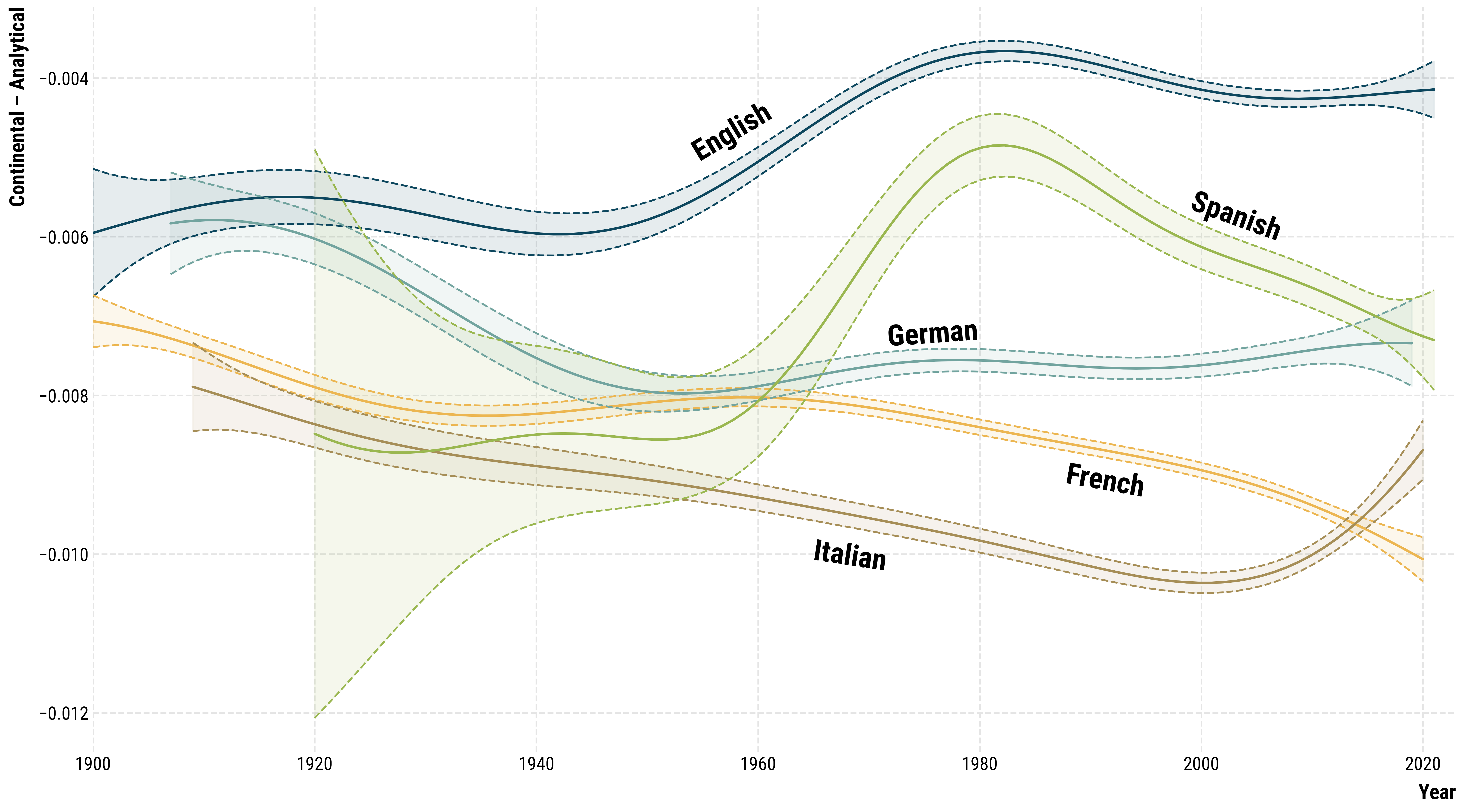
Languages Overview

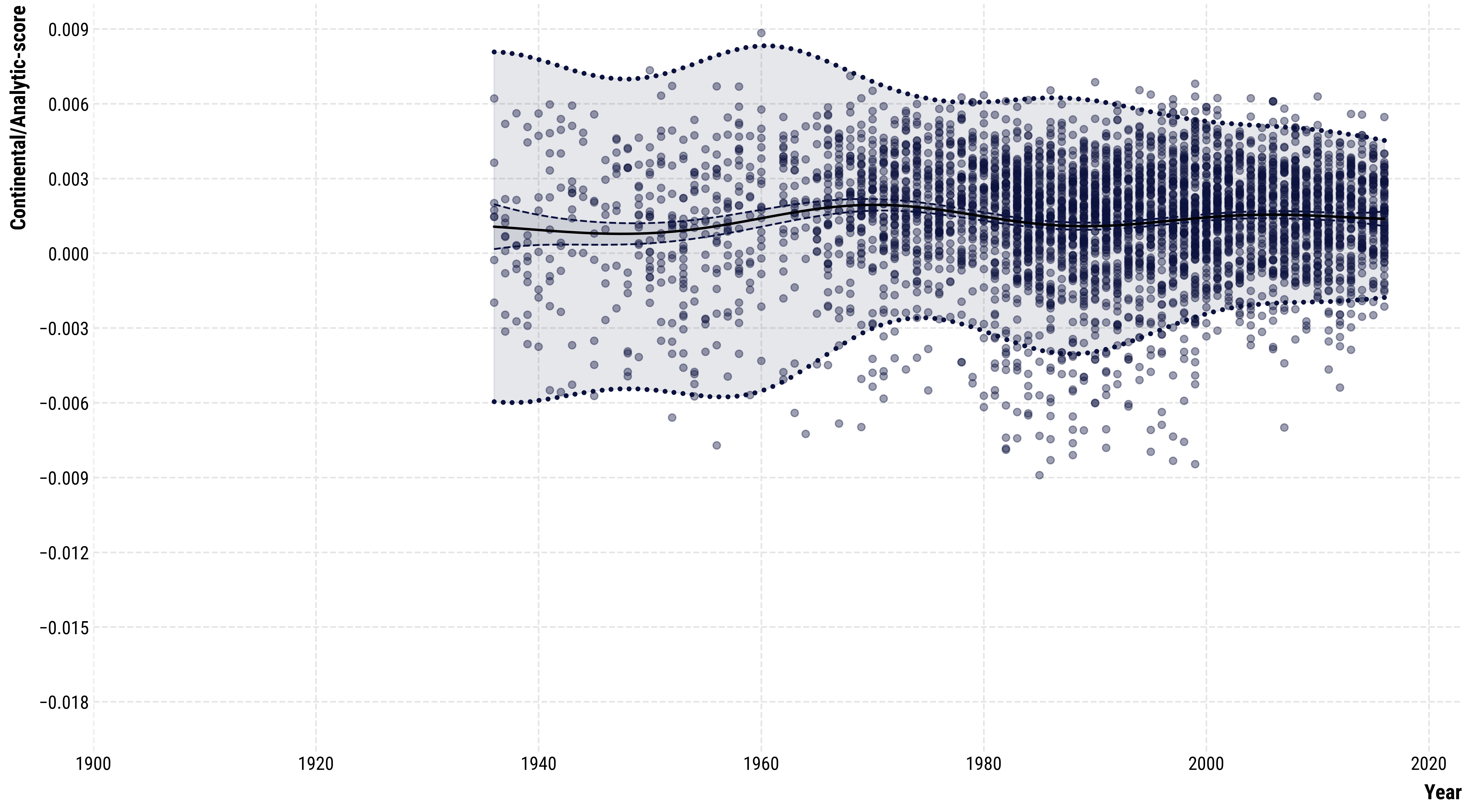
Modeling Movements

  • Open question: Common problem in DH and CSS: no obvious model.
  • Our attempts:
    • Quantile Regression (with BART or splines)
    • Split GMM Regression with GAMs
    • Mixture Density Networks

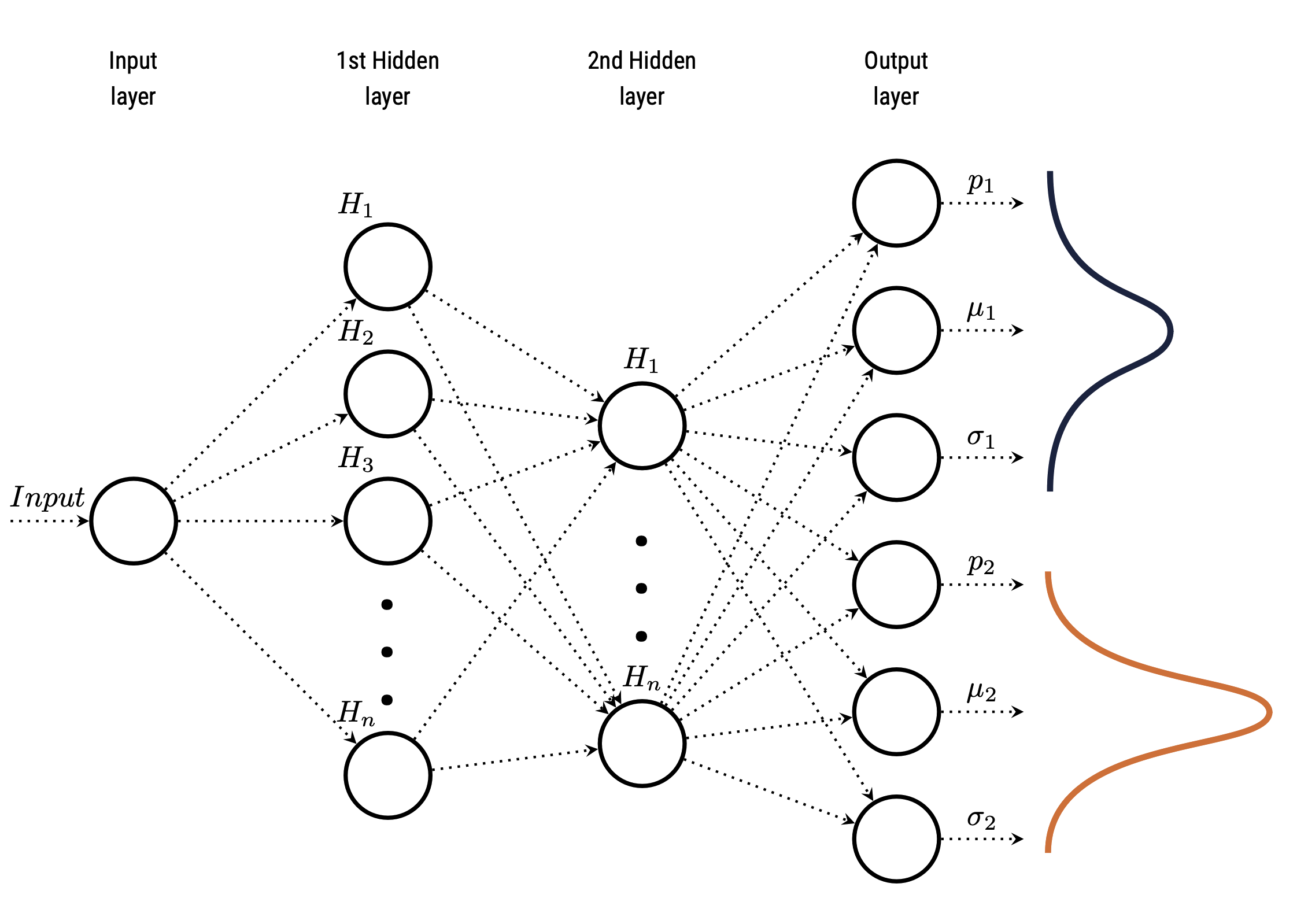
Mixture Density Networks

  • Version of NN-regression coupled with a Gaussian Mixture model.
  • Finding Parameters via Bayesian Optimization of BIC and k-fold cross-validation.

MDN Distributions
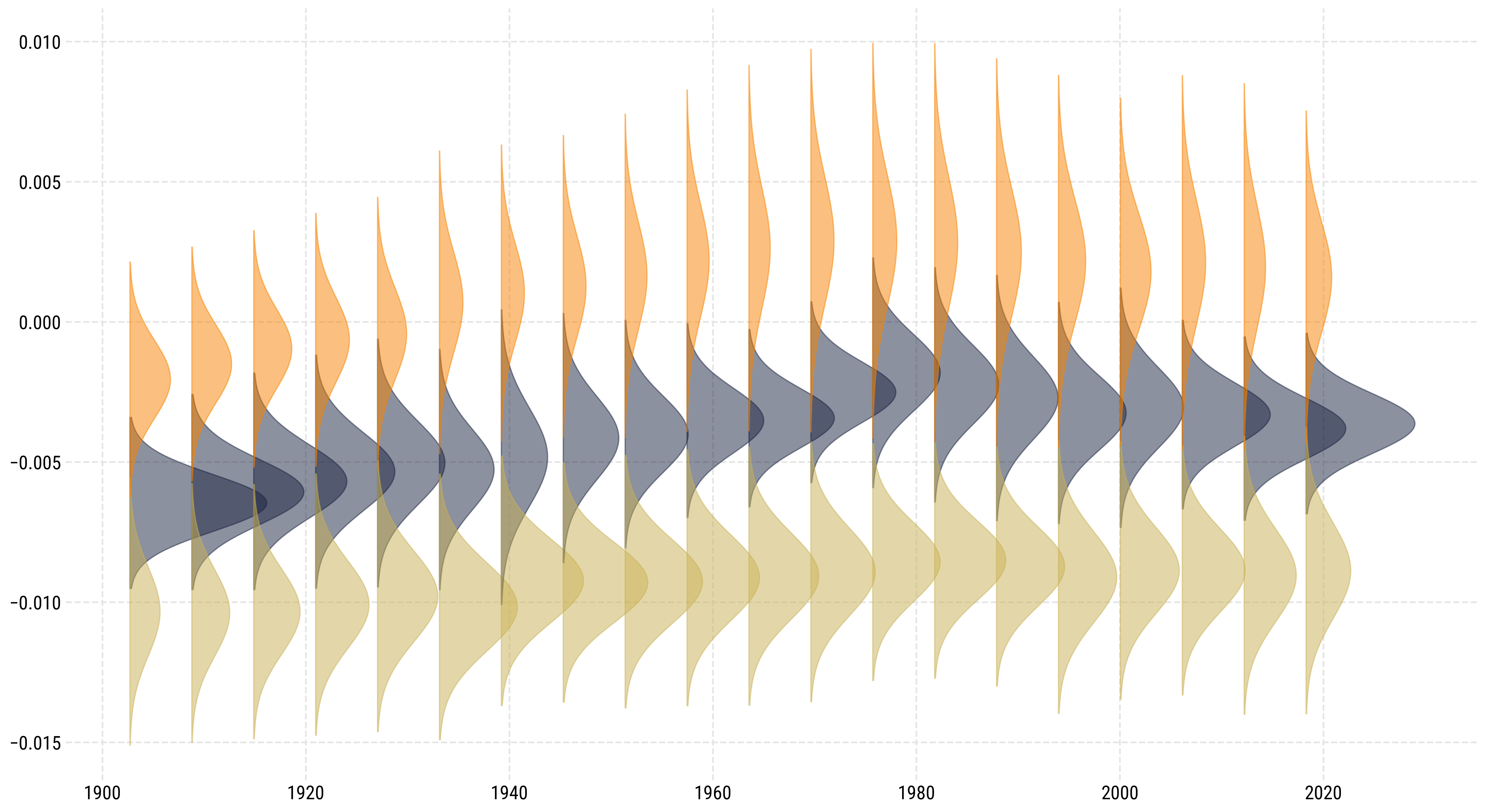
A look at gender-distributions

  • Philosophy appears to have of the lowest shares of women among graduates & faculty among the humanities.
  • Various explanation-approaches - disciplinary culture seems important.
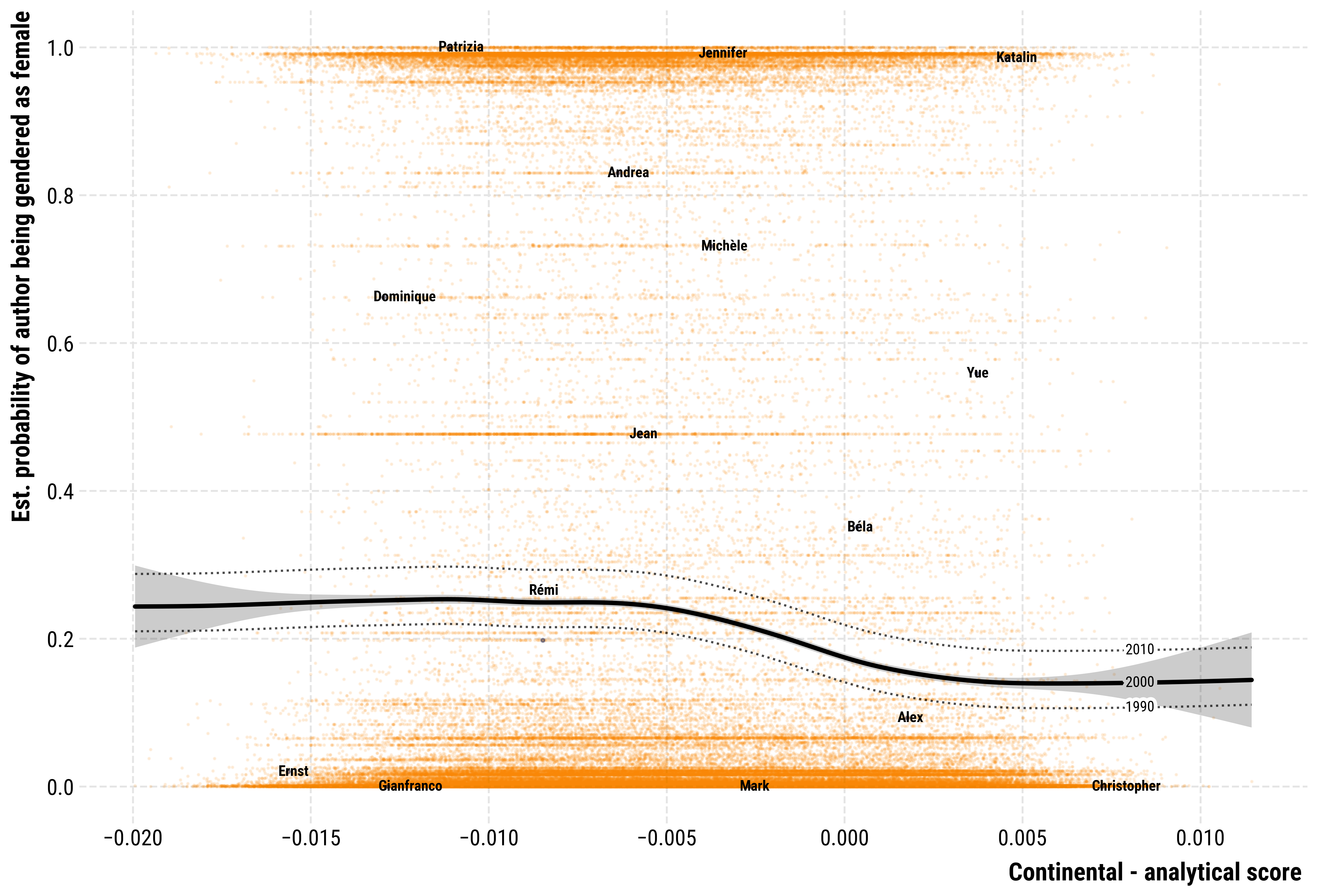
  • Estimate along the Cont.-analyt.-divide.
  • Probabilistic model of gendered-as, derived from first names.

Gender Distribution

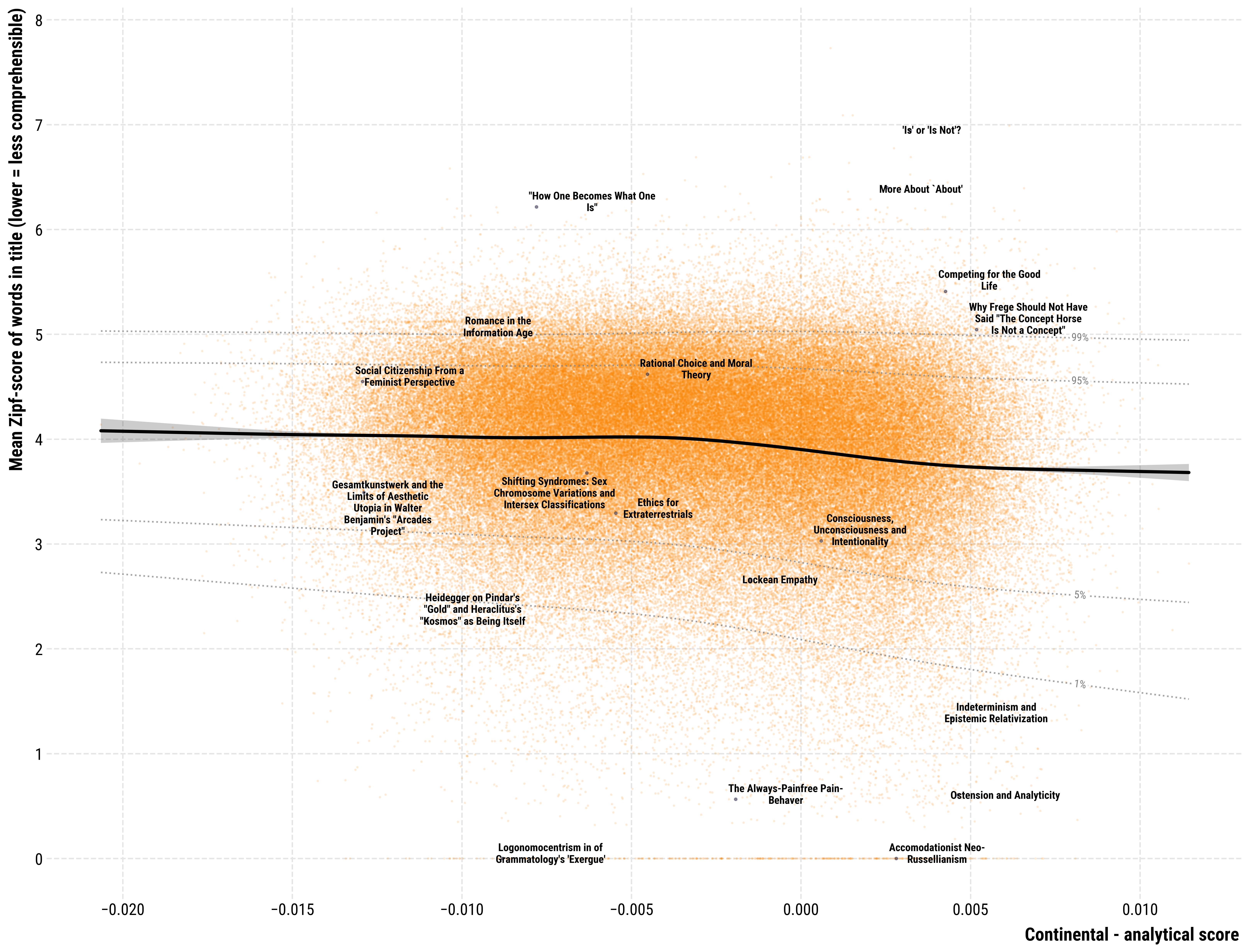
Who’s more incomprehensible?

  • Clarity & comprehensibility as values in philosophy
  • Calculate averages of Zipf-scores (here in titles):
  • \(\text{Zipf Frequency} = \log_{10}\left(\frac{\text{Word Count}}{10^9}\right)\)
  • Indicator of specialization, general societal engagement?

Comprensibility

Thank you!

Literature

Betti, Arianna. “Towards a Computational History of Ideas.” CEUR Workshop Proceedings, no. 1681 (2016): 13.
Foucault, Michel. The Order of Things: An Archaeology of the Human Sciences. Vintage books edition. New York NY, 1994.
Herfeld, Catherine, Jan Müller, and Kathrin Von Allmen. Why Do Women Philosophy Students Drop Out of Philosophy? Some Evidence from the Classroom at the Bachelor’s Level.” Ergo an Open Access Journal of Philosophy 8, no. 0 (December 2022).
Heßbrüggen-Walter, Stefan. Offene Daten für Die Digitale Philosophie: Anforderungen an Eine Datensammlung Zur Philosophie Und Ihrer Geschichte.” Trier, Luxemburg, March 2023.
Hobbs, Valerie. Accounting for the Great Divide: Features of Clarity in Analytic Philosophy Journal Articles.” Journal of English for Academic Purposes 15 (September 2014): 27–36.
Husserl, Edmund. The Crisis of European Sciences and Transcendental Phenomenology: An Introduction to Phenomenological Philosophy. 6th pr. Studies in Phenomenology & Existential Philosophy. Evanston, Ill, 1984.
Katzav, Joel. Analytic Philosophy, 1925–69: Emergence, Management and Nature.” British Journal for the History of Philosophy 26, no. 6 (2018): 1197–1221.
Lean, Oliver M., Luca Rivelli, and Charles H. Pence. Digital Literature Analysis for Empirical Philosophy of Science.” The British Journal for the Philosophy of Science, April 2021, 715049.
Leslie, Sarah-Jane, Andrei Cimpian, Meredith Meyer, and Edward Freeland. “Expectations of Brilliance Underlie Gender Distributions Across Academic Disciplines.” Science 347, no. 6219 (2015): 262–65.
Martínez, Alejandro, and Stefano Mammola. Specialized Terminology Reduces the Number of Citations of Scientific Papers.” Proceedings of the Royal Society B: Biological Sciences 288, no. 1948 (April 2021): rspb.2020.2581, 20202581.
McInnes, Leland, John Healy, and James Melville. UMAP: Uniform Manifold Approximation and Projection for Dimension Reduction.” arXiv:1802.03426 [Cs, Stat], February 2018.
Neurath, Otto, Hans Hahn, and Rudolf Carnap. Wissenschaftliche Weltauffassung: Der Wiener Kreis.” In Empiricism and Sociology, edited by Marie Neurath and Robert S. Cohen, 299–318. Vienna Circle Collection. Dordrecht, 1973.
Noichl, Maximilian. Modeling the Structure of Recent Philosophy.” Synthese 198, no. 6 (June 2021): 5089–5100.
Reimers, Nils, and Iryna Gurevych. Making Monolingual Sentence Embeddings Multilingual Using Knowledge Distillation.” October 2020.
———. Sentence-BERT: Sentence Embeddings Using Siamese BERT-Networks.” August 2019.
Strassfeld, Jonathan. American Divide: The Making of Continental Philosophy.” Modern Intellectual History 17, no. 3 (September 2020): 833–66.
Waller, Isaac, and Ashton Anderson. Community Embeddings Reveal Large-Scale Cultural Organization of Online Platforms.” arXiv:2010.00590 [Cs], October 2020.
Wittgenstein, Ludwig. Tractatus Logico-Philosophicus. Translated by Charles Ogden. 2010.