The Equality Effect (?)

Empirically calibrated network variants for social epistemology

AuthorsMax Noichl

Occasion CSPS

Date 4 May 2026

Introduction

  • Max Noichl, Utrecht University, PhD candidate in theoretical philosophy.
  • Computational methods in philosophy.
  • Interested in cognitive dynamics of philosophy, scientific model transfer, scientific information flow, AI creativity…
  • Presenting work with Hein Duijf (Utrecht) and Ignacio Quintana (LMU).
  • Follow along at www.maxnoichl.eu/talk.

Network Epistemology

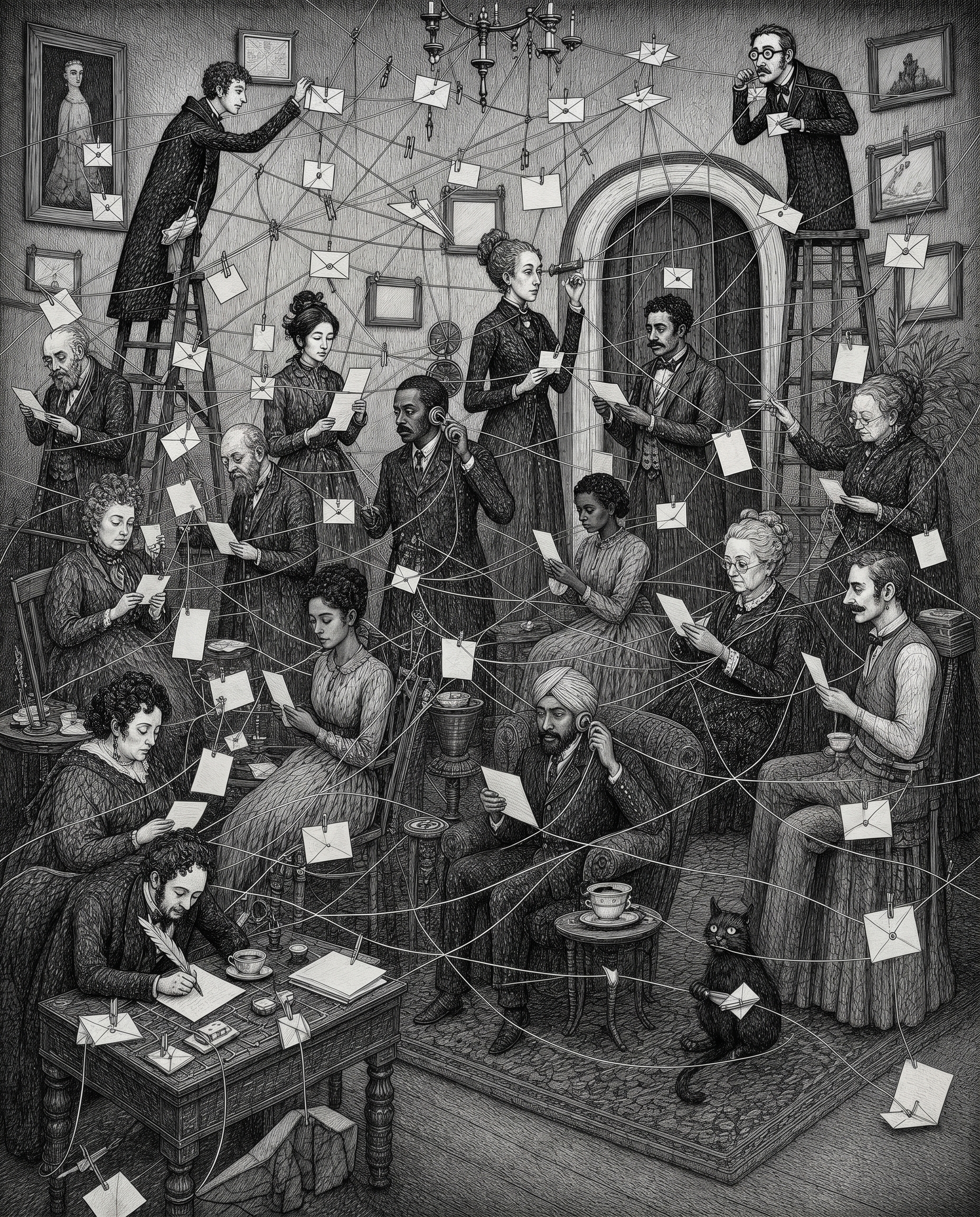
  • Network Epistemology: collective inquiry is moderated by social structures…
  • …which can be modeled as networks…
  • … on which we can run agent based models.

Recap: Zollman (2010)

  • Classic set-up: Agents (scientists) evaluate two competing methods, with similar, but slightly different quality (bandit problem mirroring clinical trials). They communicate their evidence on a network.
  • Agents cease evaluating methods they believe to be inferior.
  • Results:
    1. Less connectivity can lead to more reliable groups.
    2. Community structure matters!

Illustration of the Zollman network effect

Limitations of the Literature

  1. Simulation studies usually use small networks.
  2. Simple network structures. Open
  3. Highly unequal degree distributions are empirically common, but underexplored.
  4. Data-driven tests of whether findings transfer to empirically calibrated networks remain rare.

What do we want?

  • Anchor ABMs in real-world networks.
  • Explore close counterfactual network settings.
  • Alter networks systematically.
    • Density denser sparser
    • Degree equality more equal less equal
    • Clustering more clustered less clustered
  • But: networks are interconnected.
  • We can’t easily intervene on individual network properties.
Denser network intervention Sparser network intervention More equal network intervention Less equal network intervention More clustered network intervention Less clustered network intervention

Simulated Annealing

  1. Optimize network changes with simulated annealing. Open demo
  2. Choose one target network statistic and keep the others within narrow bands.
  3. Propose local edge edits: add, remove, or switch edges.
  4. Optimize until the target is reached. Then keep all values constant, and minimize edit distance. Example

Our Real-World Networks

  • Collect three networks commonly discussed in social epistemology:
    1. Discovery of the cause of peptic ulcer (n = 90, m = 160).
    2. Acceptance of smoking as a cause of cancer (n = 289, m = 1,229).
    3. Publication bias on the ego depletion effect (n = 503, m = 2,933).
  • Collect directed citation networks via keyword search on OpenAlex.
  • Merge authors into informational units.

Network Variants

Simulation Setup

  • Produce 300 evenly spaced network variants around each target network.
  • Run 10,000 Zollman (2010)-style simulations for each network variant.
  • Randomly vary the number of experiments per agent (\(10^3\) to \(10^4\)) and problem easiness (\(10^{-6}\) to \(10^{-3}\)).
  • Measure share of correct agents after 1000 steps.

Results and Statistical Analysis
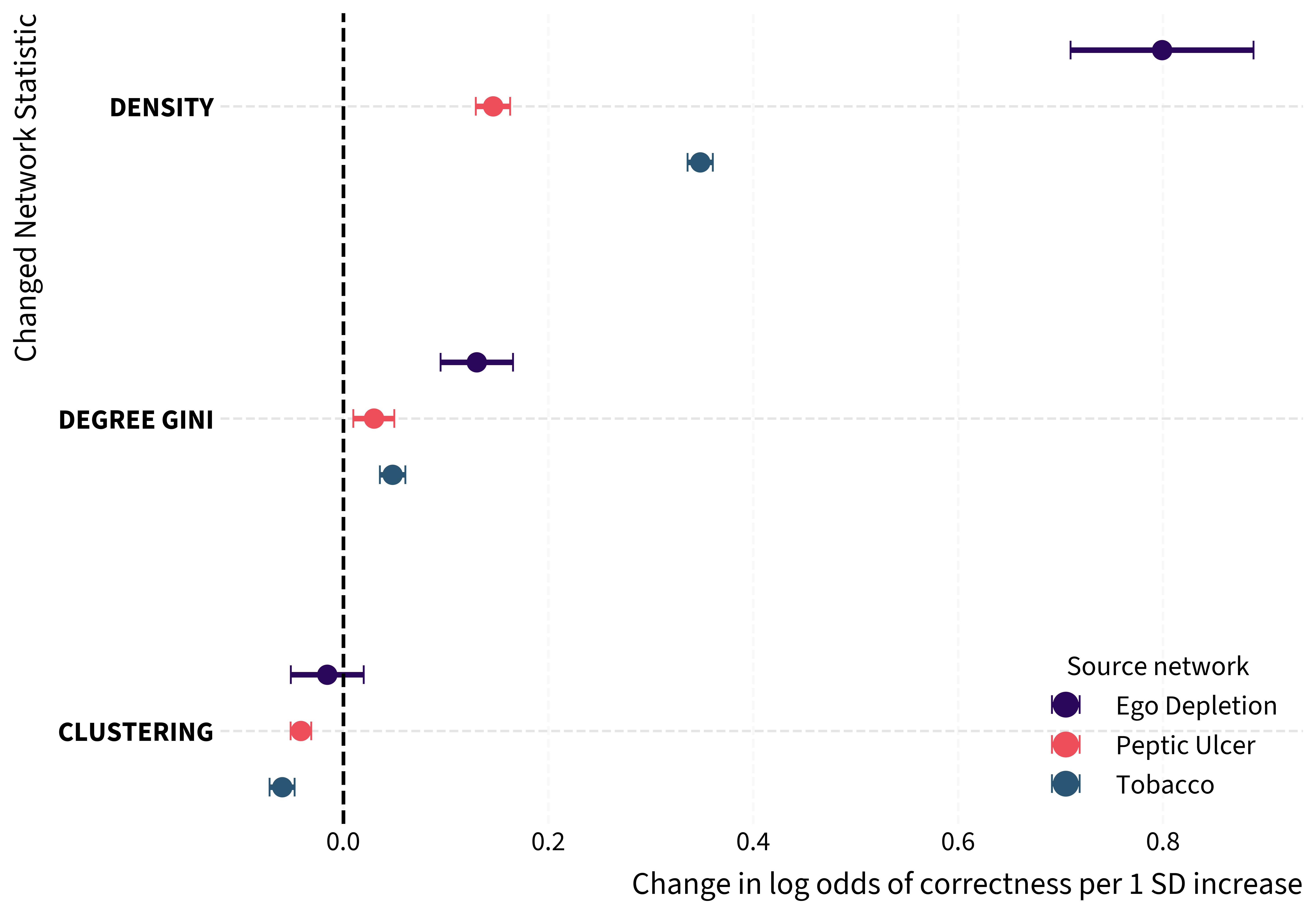
Targeted statistics forest plot

Estimated effects, in log odds, of each varied network statistic on the share of agents correct at convergence, controlling for problem easiness and number of experiments. Horizontal bars show 95% confidence intervals. The vertical dashed line marks no effect; values to the right indicate higher predicted agent correctness.

In data-units
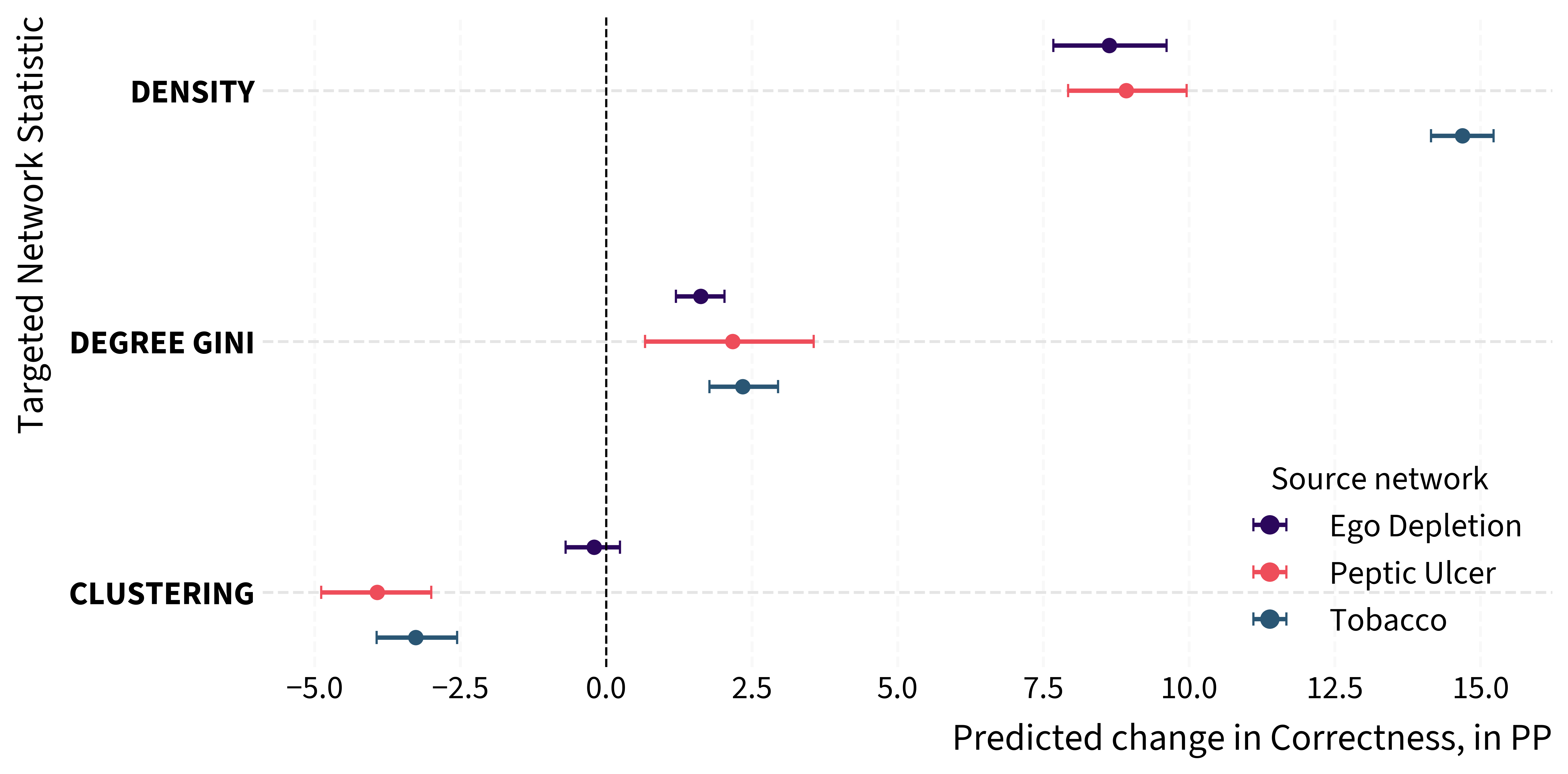
Targeted statistics forest plot

By how many percentage points is correctness increased, when moving from the 10th to the 90th percentile of the network statistic.

Summary

  • Classic network epistemology effects persist on empirically calibrated networks…
  • … but tend to be small to medium-sized.
  • Density, contra Zollman, appears uniformly positive…
  • …but no perfect comparison yet.
  • Higher degree inequality can be useful; more clustering, harmful.

Take-away

Figuring out how to empirically anchor ABMs is crucial, if we want to make claims beyond our models.

Literature

Albert, Réka, and Albert-László Barabási. 2002. “Statistical Mechanics of Complex Networks.” Reviews of Modern Physics 74 (1, 1): 47–97. https://doi.org/10.1103/RevModPhys.74.47.
Baumeister, Roy F., Ellen Bratslavsky, Mark Muraven, and Dianne M. Tice. 1998. “Ego Depletion: Is the Active Self a Limited Resource?” Journal of Personality and Social Psychology 74 (5): 1252–65. https://doi.org/10.1037/0022-3514.74.5.1252.
Carter, Evan C., and Michael E. McCullough. 2014. “Publication Bias and the Limited Strength Model of Self-Control: Has the Evidence for Ego Depletion Been Overestimated?” Frontiers in Psychology 5. https://doi.org/10.3389/fpsyg.2014.00823.
Frey, Daniel, and Dunja Šešelja. 2018. “What Is the Epistemic Function of Highly Idealized Agent-Based Models of Scientific Inquiry?” Philosophy of the Social Sciences 48 (4): 407–33. https://doi.org/10.1177/0048393118767085.
Jonard, Nicolas, Samuli Reijula, and Luigi Marengo. 2025. “Theory Choice in Epistemic Networks: Five Ways to Avoid Premature Convergence.” https://philsci-archive.pitt.edu/26427/.
Kummerfeld, Erich, and Kevin J. S. Zollman. 2016. “Conservatism and the Scientific State of Nature.” British Journal for the Philosophy of Science 67 (4): 1057–76. https://doi.org/10.1093/bjps/axv013.
Radomski, Bartosz Michał, Dunja Šešelja, and Kim Naumann. 2021. “Rethinking the History of Peptic Ulcer Disease and Its Relevance for Network Epistemology.” History and Philosophy of the Life Sciences 43 (4): 113. https://doi.org/10.1007/s40656-021-00466-8.
Rosenstock, Sarita, Justin Bruner, and Cailin O’Connor. 2017. “In Epistemic Networks, Is Less Really More?” Philosophy of Science 84 (2): 234–52. https://doi.org/10.1086/690717.
Weatherall, James Owen, Cailin O’Connor, and Justin P. Bruner. 2020. “How to Beat Science and Influence People: Policymakers and Propaganda in Epistemic Networks.” The British Journal for the Philosophy of Science 71 (4): 1157–86. https://doi.org/10.1093/bjps/axy062.
Zollman, Kevin J. S. 2007. “The Communication Structure of Epistemic Communities.” Philosophy of Science 74 (5): 574–87. https://doi.org/10.1086/525605.
———. 2010. “The Epistemic Benefit of Transient Diversity.” Erkenntnis 72 (1): 17–35. https://doi.org/10.1007/s10670-009-9194-6.
———. 2013. “Network Epistemology: Communication in Epistemic Communities.” Philosophy Compass 8 (1): 15–27. https://doi.org/10.1111/j.1747-9991.2012.00534.x.