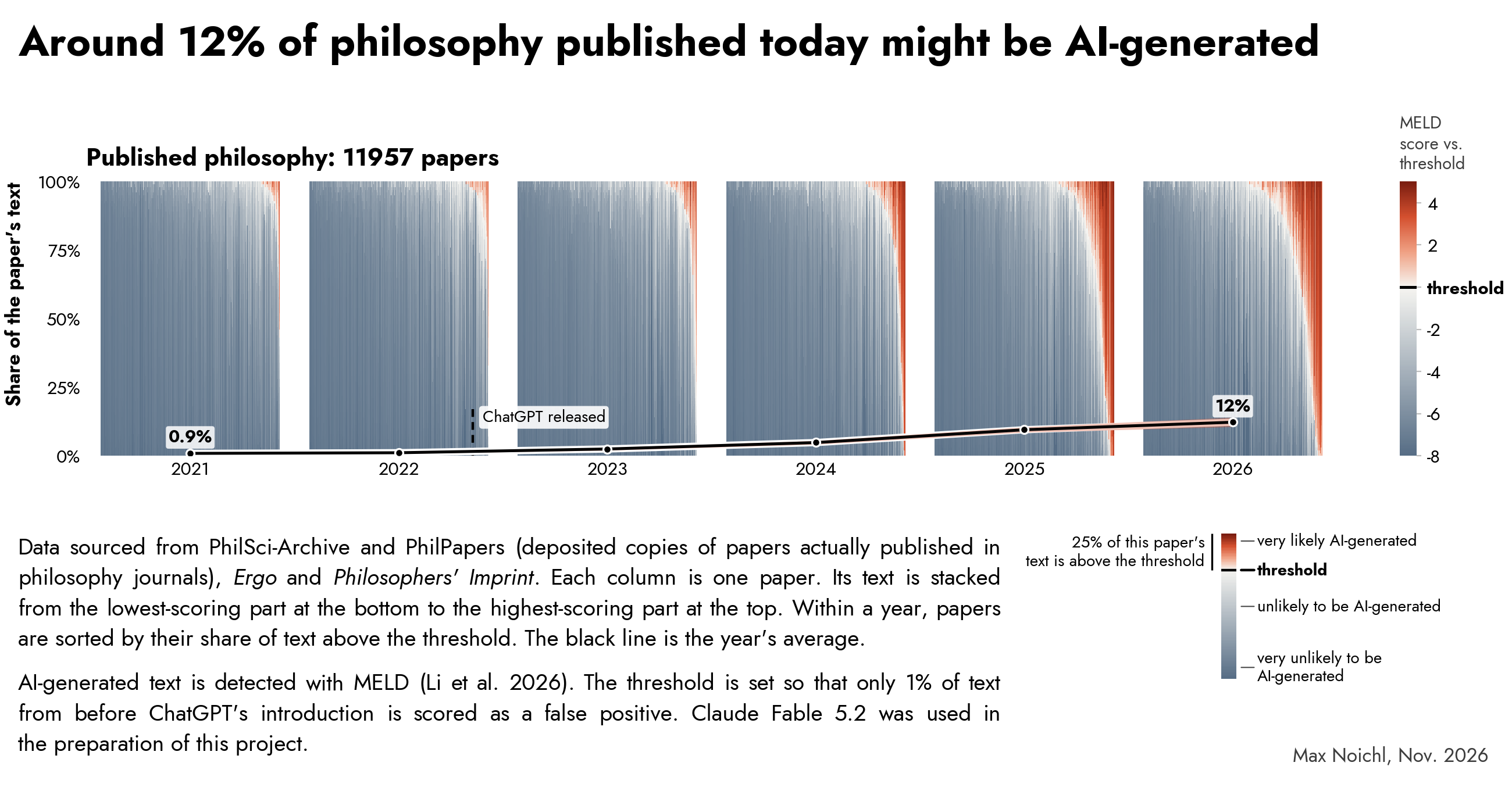
Around 12% of philosophy published today might be AI-generated
When reading philosophy in the last few months, I’ve often had the nagging feeling that what I’m reading had a distinct AI smell. I thus wanted to investigate the prevalence of AI usage in philosophy in a data-driven way. This post outlines the results of that investigation. Long story short, it seems that philosophers have started to make substantial use of AI in their papers, and it’s not uncommon for AI-generated text to make it into philosophy published in decent journals. It also appears that preprint servers in philosophy are increasingly clogged up by AI-generated content.
Here’s what the results look like, at a glance:
Methods and Data
AI detection is funny in that, around three years ago, it was extremely bad and unreliable. Many people thought it might even be impossible to detect AI-generated content at all. This changed sometime over the last year, as more reliable AI detectors like Pangram (Emi & Spero, 2024) came on the market. Now the best AI detection systems appear to be pretty reliable (Jabarian & Imas, 2025) at least under decent conditions (enough text, English language, etc.). This means that for some time now, many people have been heavily underestimating how detectable AI writing is in practice. This doesn’t mean that it’s a fully solved problem. For one, it remains tricky to distinguish between AI-based editing, translation, and full generation, especially for very short texts, and there is the danger that new large language models might, at least temporarily, get ahead of the detectors. But right now AI detection with reasonable confidence is possible.
For this project, I will be using an open-source AI detector called MELD, published by Li et al. (2026). MELD is based on a transformer model, Ettin-1B, from the ModernBERT family.
Transformer models (very) roughly work such that text is split into small subword units called tokens. These tokens get individual numerical representations called embeddings, and as text is pushed through the model, in a process called attention, the embeddings of individual tokens change based on the tokens around them, encoding contextual semantics, grammar and so on. In LLMs these embeddings are usually randomly initialized at the beginning of the training process and then iteratively updated, so that the embeddings that drop out at the end of the model become more useful for specific tasks, for example, predicting the next token for text generation in GPTs or predicting a token from its surroundings (in BERT-style models). For an interactive walkthrough of these steps, I like to recommend the Transformer Explainer.
In the case of MELD, a model pre-trained on general text tasks is trained further. To make it work for the task of AI detection, a small additional neural network, which projects the large token embeddings coming out of it to a much lower, 48-dimensional space, is added on top of it, as well as two small sets of anchor vectors, one which contains vectors meant for different AI-model families and one for humans. The model is then trained further, now on a mixture of texts for which we know whether they are AI-generated or human. As the model is trained, each token in each incoming text is compared to all anchors, and its similarity to the most AI and the most human-like prototype is scored. These scores are used for a general prediction on the text, and depending on how it gets its predictions right, the prototypes used in each training step, as well as the whole network leading up to them, get updated (Li et al., 2026). MELD can, in principle, try to distinguish between different types of AI usage (raw generation, polishing, etc.), but for our current investigation we are looking for any content that appears to have come out of, or gone through, an AI model in any form.
In my experience so far, MELD performs pretty well. I suspect it is not quite as good as Pangram, especially with regard to the most recent state-of-the-art models. It has the big advantage, though, that it is open source, so we can check how it works under the hood, what it was and wasn’t trained on, and how it performs on our specific datasets. It also means that we can run it ourselves if we acquire a strong enough GPU, which costs a little bit of money, but is far less expensive than running a large number of philosophy papers through Pangram, which would charge around 5 dollars per paper. This also means that potentially copyrighted material can stay on machines that we control. I couldn’t get access to the canonical weights of MELD, so I have been using this mirror.
MELD uses a threshold approach. When using the frozen weights after training is done, each token gets its own AI score, and we can decide ourselves at what threshold we want to assume that the text is actually AI-generated. The MELD authors recommend setting the threshold on material that we know is not AI-generated, which we do for each individual dataset in this project based on the papers from 2021 and 2022, as ChatGPT in its earliest version was introduced in November 2022. For the presented results, we set the threshold so that we accept a 1% false positive rate in those pre-AI years, which is the more strict of the thresholds suggested by the authors of MELD for the results reported in their paper. On their own evaluation dataset, at a 1% false positive rate, they detect 99.7% of AI texts successfully.
I should note that this is significantly less strict than Pangram’s reported overall false positive rate of one in 10,000 (Emi, 2025). As I am not trying to judge individual authors’ work for potentially life-changing decisions, but to get a general sense of how things are going in philosophy, I am just as worried about the model missing more subtle cues of AI writing (false negatives), as I am about false positive judgements.
For the data, we are considering four publicly available sources of philosophical articles, namely the journals Philosophers’ Imprint and Ergo, which are, to my mind, well-respected venues that have the big advantage of being fully and freely available on the internet. I have gently scraped these two publications, as well as all the preprints on the PhilSci-Archive. I also downloaded all preprints available from PhilPapers’ PhilArchive via the CORE collection. After restricting to papers from 2021 onwards with at least 1,500 words of text (and, for PhilPapers, to English-language articles of at most 30,000 words), this leaves full texts of 197 papers from Philosophers’ Imprint, 374 from Ergo, 4723 from the PhilSci-Archive and 29954 from PhilPapers. For the final year 2026, CORE had about a third of the records available, compared to around 78% available for the earlier years, so we have a still somewhat incomplete dataset to work with right now. I noticed that many preprints were backdated (posted in 2025/26 but claimed to be from 21/22) and therefore could not reliably be considered AI free. I thus removed them from the dataset, and used only articles actually uploaded in those early years for calibration of the threshold.
For the PhilSci-Archive and PhilArchive, I linked the records to OpenAlex, which allows us to check the publication status of each paper. For this, I consider all papers that appear in a journal with an ISSN listed on the PhilPapers journal list as published in philosophy. While these papers ended up being published in some form, we should keep in mind that their deposited version is not always fully identical to the final published one. Because different genre compositions and text sources will be treated differently by MELD, I calculated separate thresholds for (1) the two open access journals, (2,3) published and only preprinted works in the PhilSci-Archive, and (4,5) published and preprinted work from PhilPapers.
All of these papers were converted from their various HTML/PDF formats into a uniform text format using BeautifulSoup (for the journals’ HTML pages) and PyMuPDF (for the PhilSci-Archive PDFs). For PhilPapers, I use the text that CORE had already extracted. The papers were then parsed with MELD using GPUs rented on Google Colab. MELD read the texts in windows of 2,046 tokens (around 1,500 words) at a time and scored every token; these token scores were then summarised in passages of 256 tokens (around 190 words). Following the procedure in the MELD paper, the MELD scores were then calculated by taking the similarity to the human prototypes as opposed to the AI prototypes, and by taking the average of the top 25% of token scores as the AI score for the whole passage.
I usually post all code and data for the analyses I do, and I believe it’s crucially important to do so for published work. In this case, however, I will not be sharing the data and code (not even privately), at least in the immediate future. AI use is a highly sensitive topic, and accusing authors of it could have implications for their careers. The idea of doing so wrongly is mortifying to me, and I don’t trust the current workflow enough to be sure that this would not happen.
I’m further not convinced that all the AI usage I find with this method is equally problematic. I think there is, for example, a big difference between AI use for translation as opposed to spamming journals with one-shot prompted slop. For these reasons, I will only be reporting aggregate values in this post and won’t be quoting from any of the AI-generated texts. I know that this is somewhat unsatisfying and makes the whole project less convincing, but for now, it seems to me to be the most responsible way of going about this.
Results
So, what do we find? First, we can look at the AI use detected in the two specific journals we have gathered: Philosophers’ Imprint and Ergo. In the graphic below, each paper’s passages are stacked from bottom to top, from the lowest detected AI use (very unlikely to be AI-generated, shown in gray) to the highest detected AI use (very likely to be AI-generated, shown in red). Each narrow column therefore represents the distribution within one paper. This shows how prevalent AI use is overall, as well as its distribution in the papers in which it occurs. Within each year, columns are arranged by the amount of AI use above the threshold, which we set based on the years 2021 and 2022.
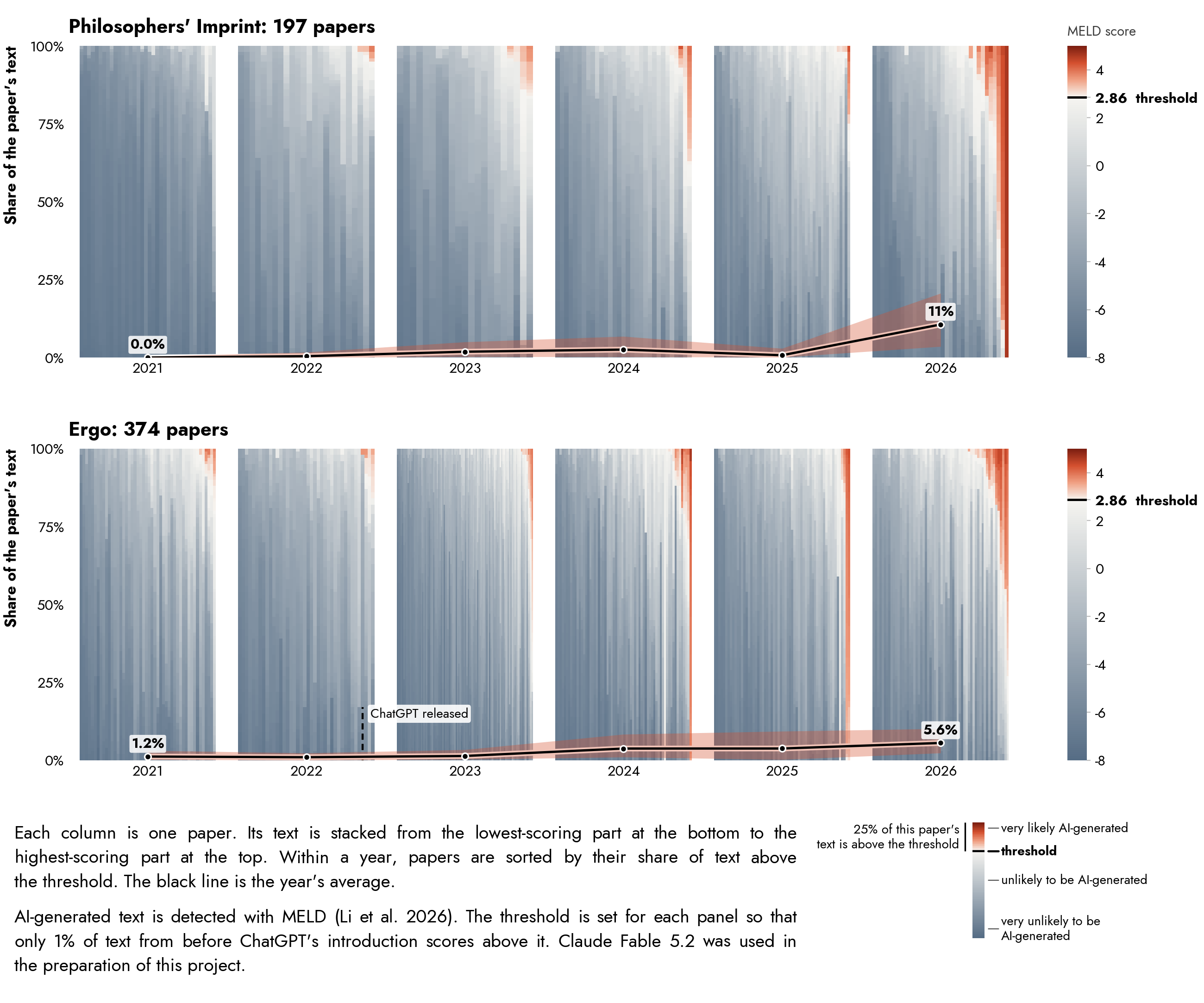
As we can see, the values before 2023 are around 1%, which corresponds to the expected false positive rate we set. After 2023, we see a slow increase in AI use in Ergo, which continues into 2026: some passages get flagged, but there are few papers with marked AI use. In Philosophers’ Imprint, usage stays low until 2025 and then seems to rise considerably in 2026. In both journals, we now see papers that contain at least sizable chunks of material that likely passed through a large language model in some way. I haven’t been able to find an AI policy for Philosophers’ Imprint, but Ergo considers AI-generated content to be usually inappropriate, and in any case, such use has to be disclosed (Ergo, 2026).
At this point, I feel like I should reiterate that I included these two journals because they are fully open access. They are the only way I could study the full run of individual philosophy journals without worrying about the issues around bulk-downloading licensed material. There is no indication that these journals are particularly full of AI material: To the contrary, as we will see, they appear to be around, or even below average.
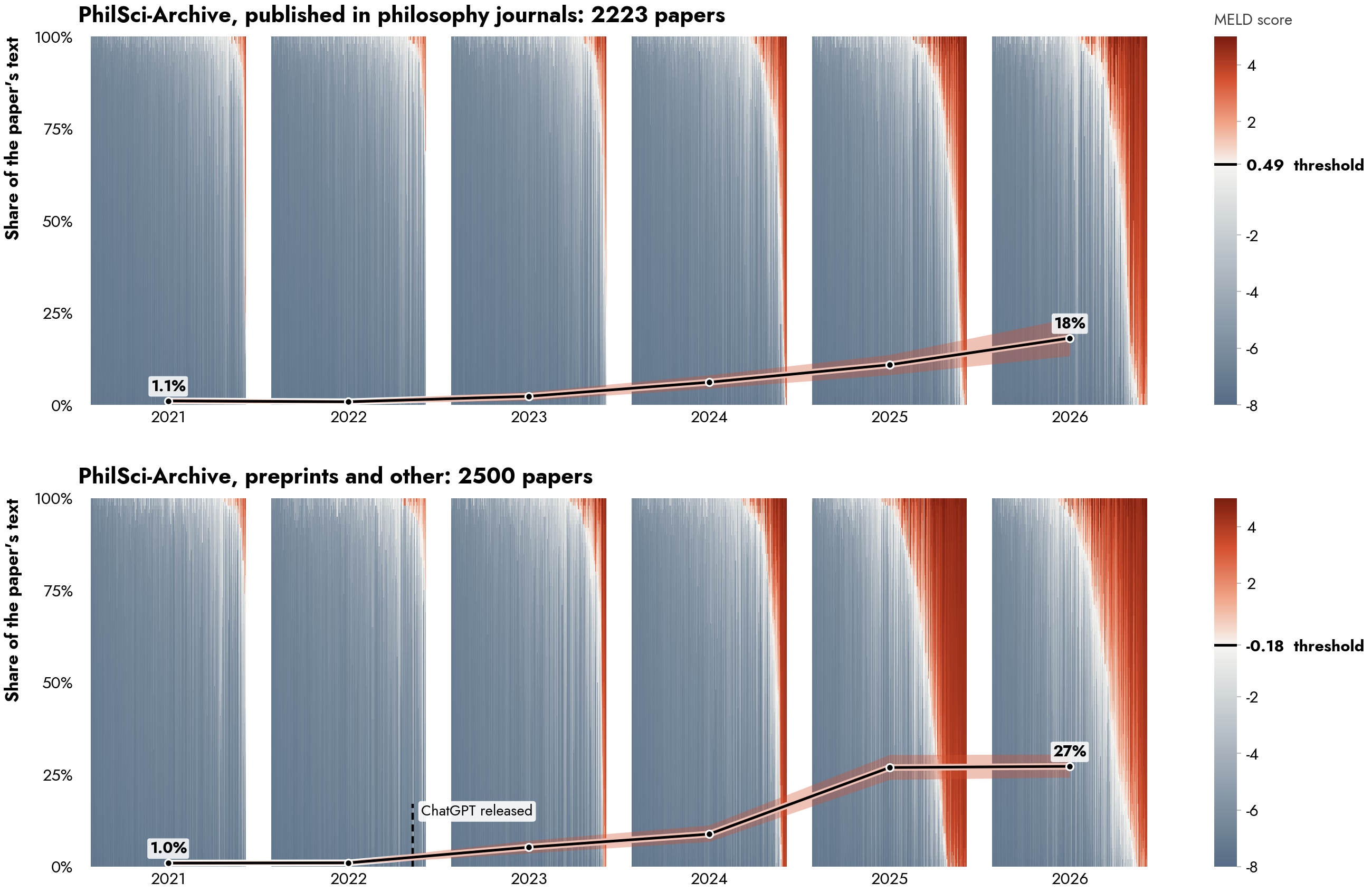
Turning to the PhilSci-Archive, which in the study period yielded 4723 papers in total, I’ve split these into papers that have been published in philosophy journals, according to the PhilPapers journal list and OpenAlex, and papers that have remained preprints or were published in other venues that are either not considered philosophy by PhilPapers or are book reviews, contributions to collected volumes, and so on. Here we seem to find much higher shares of AI content in 2026, with 18% of material published in philosophy journals showing evidence of AI generation and a number of the papers scoring uniformly quite high. An even higher share, 27% of the textual material uploaded to the PhilSci-Archive as preprints, is considered as AI-generated by MELD. It also appears that most papers that make use of AI are by no means fully AI-generated, but have more or less extended passages in them that get flagged. But there are a few largely AI-generated papers that appear to have made it into publication.
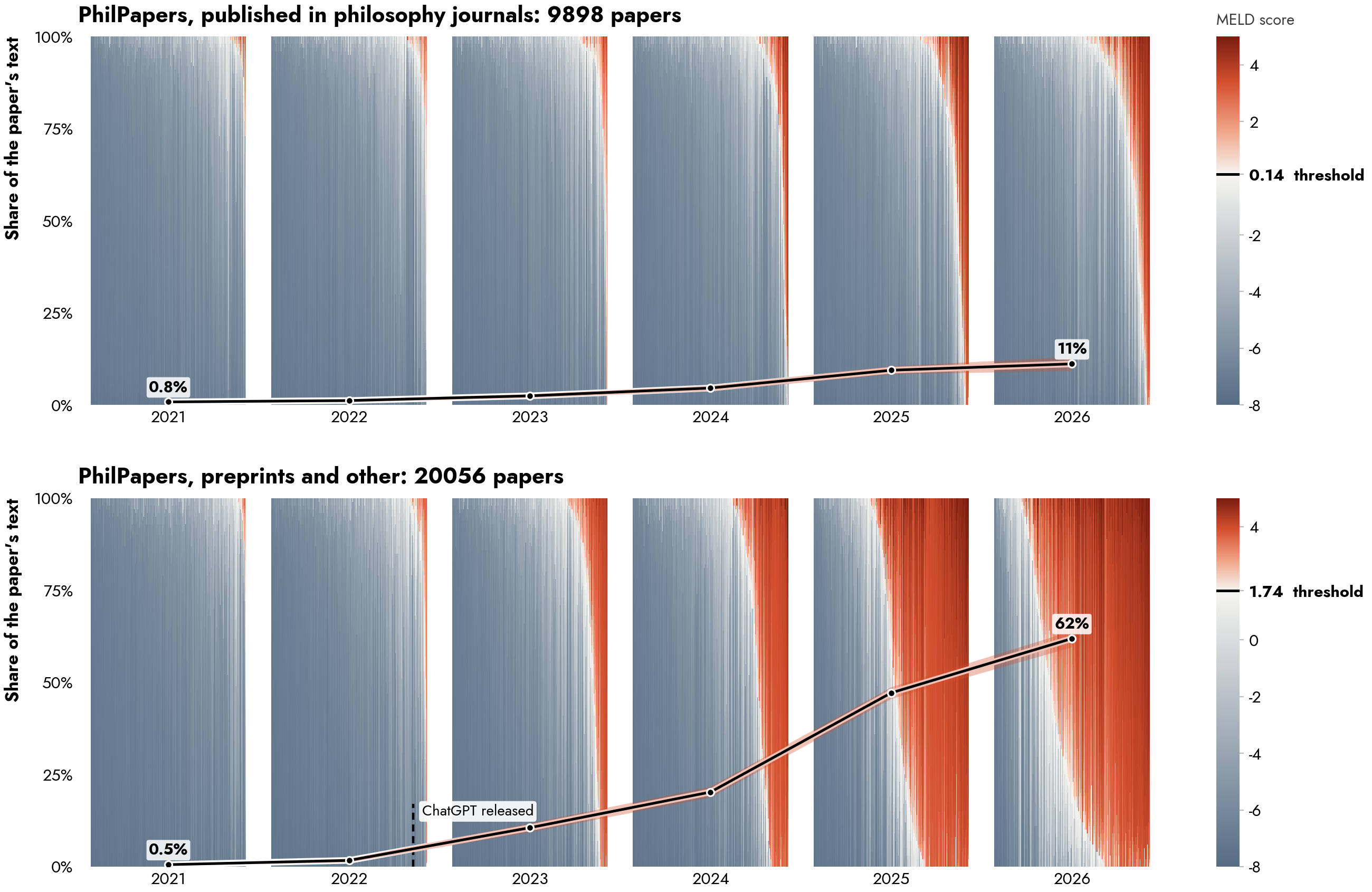
We find a somewhat similar preprint/published split for papers that have come online via PhilPapers’ PhilArchive. Around 11% of published material seemed to be AI-generated in 2026, and a stunning 62% of the material that was uploaded to PhilPapers in 2026 and has not yet gone on to be published in philosophy journals appears to be AI-generated. Manually checking these results, it appears that much of this material is actually barely related to philosophy. This is in contrast to the PhilSci-Archive, which doesn’t have a pronounced rise from 2025 to 2026. One explanation may be that the new moderation policies the PhilSci-Archive put into place in June 2026 are working.
If we combine (and deduplicate) all samples that got published in philosophy journals from PhilPapers, the PhilSci-Archive, Ergo and Philosophers’ Imprint, and score them according to their own thresholds, we arrive at the figure at the top of this post, an estimate of 12% of published philosophy in 2026 involving some AI assistance.
Qualifications and Summary
I have checked a few dozen of the highest-scoring passages from all of these datasets, both manually and using Pangram. Many of them do hold up, and I will say that I have been surprised, and a little shocked, to find extended passages of writing in decent journals, where my intuitive reading, the MELD scoring, and the Pangram spot checks have all agreed on AI use. So one conclusion of this project is that AI use in philosophy is here. I think it is prevalent, even in well-respected journals.
I should also note that, as should be expected from their different accepted false-positive rates, MELD seems to be much more aggressive than Pangram in flagging text as AI. What I’ve often seen during manual checking is that MELD flags long stretches as AI-involved writing, whereas Pangram flags only smaller chunks within those texts. But, when something does get flagged highly by MELD, Pangram usually is also at least suspicious, giving non-zero AI-use scores or indications of AI-assistance.
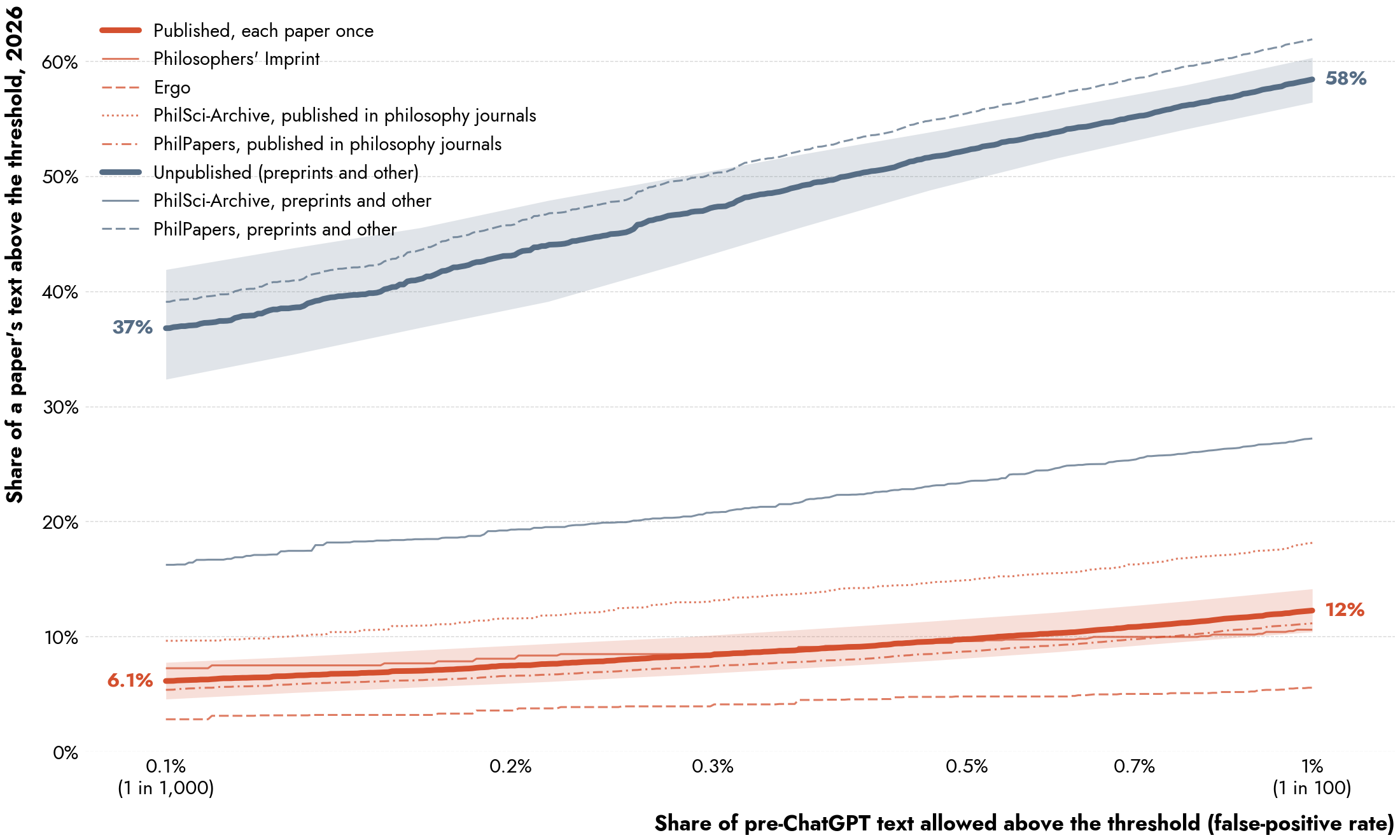
If we want to be more careful in our estimates (which might also mean letting a big chunk of AI content slide), we can make our threshold more severe. Lowering the accepted false positive rate in 2021/2022, e.g. to one in a thousand, we would get 6% of material flagged in papers published in journals in 2026, and 37% in preprints. The plot below shows how results change with the threshold. That being said, I lean towards accepting that MELD is currently giving less reliable, and likely higher, estimates than Pangram would. A more thorough study than this one might very well be worth the effort, and show a different picture.
I have also seen a number of clear failure modes of this approach. The first is that some papers fully marked as AI-generated are, after reading into them, likely to be papers where people used AI translation. These papers have a distinct “AI smell” in their phrasing but seem well thought out and were published by people that I assume might not be native speakers of English. While I personally would caution against doing this as an author, I don’t think this is a particularly problematic use of AI (especially in view of recent work on linguistic inequality in philosophy, see Marsili & Rehren (2026), Peters et al. (2025)), even if I would prefer to see that disclosed.
Another failure mode I have observed is when authors are writing about AI and put long, correctly marked quotations from ChatGPT or Claude into their papers. It’s nice to see that MELD catches these instances, but of course these results should be considered spurious as well.
Finally, I have observed a small number of cases where material on Asian philosophy that made use of many Chinese characters in the text was flagged as AI-generated. One notable case of this was flagged only by MELD and not by Pangram, which makes me think this might be a problem area where MELD may need some additional improvement.
So, to summarize our findings: Most philosophy published in 2026 probably was not generated with AI. But AI-generated material appears to be increasingly prevalent in philosophical writing. Most papers that get flagged for AI usage seem to take the form of localized editing, where people intersperse AI-generated or AI-assisted passages with their own writing. Fully AI-generated, “slop” papers, do occur but are still relatively rare, although they drive a lot of the total AI volume. And finally, it appears that the preprint archives in philosophy, which I think are very good for the discipline, have an increasingly big AI problem, as they are getting swamped with large numbers of likely AI-generated papers. Some forms of automated AI checking might become necessary here in the near future.
It seems that AI-assisted writing has fully arrived in philosophy and is unlikely to go away any time soon. I think it is important that we have an honest and open discussion about the ways in which it is, and is not, acceptable.
I’m grateful to Hein Duijf, Dominik Klein and Erik Stei for discussing these results with me.
AI usage statement: This blog post was largely dictated via MacWhisper. The dictation was cleaned up using Fable 5.1, and edited by me. Fable 5.2 assisted me in editing the citations, fact-checking, setting up an automated process to put in the numbers, as well as layout and typo checking. I have applied MELD to the text of the post itself, and it hasn’t flagged anything, at any of the thresholds used. The code for the underlying analysis was generated using Fable 5.2, under my close supervision.
Bibliography
- Emi, B. (2025). All about false positives in AI detectors. Pangram blog, 15 September 2025. https://www.pangram.com/blog/all-about-false-positives-in-ai-detectors
- Emi, B., & Spero, M. (2024). Technical Report on the Pangram AI-Generated Text Classifier. arXiv:2402.14873. https://arxiv.org/abs/2402.14873
- Ergo (2026). Publication ethics. https://journals.publishing.umich.edu/media/journals/24/publication_ethics_ergo_2026.pdf
- Jabarian, B., & Imas, A. (2025). Artificial Writing and Automated Detection. NBER Working Paper 34223. https://www.nber.org/papers/w34223
- Li, C., Wan, C., Chen, H., & Paetzold, J. C. (2026). MELD: Multi-Task Equilibrated Learning Detector for AI-Generated Text. arXiv:2605.06903. https://arxiv.org/abs/2605.06903
- Marsili, N., & Rehren, P. (2026). Linguistic inequity in academia: evidence from publication patterns in philosophy, 1975–2021. Research Integrity and Peer Review. https://doi.org/10.1186/s41073-026-00252-9 (Summarised in a guest post on Daily Nous, 28 October 2026.)
- Peters, U., Cimendereli, Y. C., Davies, A., et al. (2025). Epistemic Challenges Faced by Non-native English Speakers in Philosophy: Evidence from an International Survey. Review of Philosophy and Psychology. https://doi.org/10.1007/s13164-025-00779-8