Large collections of high-dimensional data have become nearly ubiquitous across many academic fields and application domains, ranging from biology to the humanities. Since working directly with high-dimensional data poses challenges, the demand for algorithms that create low-dimensional representations, or embeddings, for data visualization, exploration, and analysis is now greater than ever. In recent years, numerous embedding algorithms have been developed, and their usage has become widespread in research and industry. This surge of interest has resulted in a large and fragmented research field that faces technical challenges alongside fundamental debates, and it has left practitioners without clear guidance on how to effectively employ existing methods. Aiming to increase coherence and facilitate future work, in this review we provide a detailed and critical overview of recent developments, derive a list of best practices for creating and using low-dimensional embeddings, evaluate popular approaches on a variety of datasets, and discuss the remaining challenges and open problems in the field.
@misc{debodt2025lowdimensionalembeddingshighdimensionaldata,title={Low-dimensional embeddings of high-dimensional data},author={de Bodt, Cyril and Diaz-Papkovich, Alex and Bleher, Michael and Bunte, Kerstin and Coupette, Corinna and Damrich, Sebastian and Sanmartin, Enrique Fita and Hamprecht, Fred A. and Horvát, Emőke-Ágnes and Kohli, Dhruv and Krishnaswamy, Smita and Lee, John A. and Lelieveldt, Boudewijn P. F. and McInnes, Leland and Nabney, Ian T. and Noichl, Maximilian and Poličar, Pavlin G. and Rieck, Bastian and Wolf, Guy and Mishne, Gal and Kobak, Dmitry},year={2025},eprint={2508.15929},archiveprefix={arXiv},primaryclass={cs.LG},url={https://arxiv.org/abs/2508.15929},}
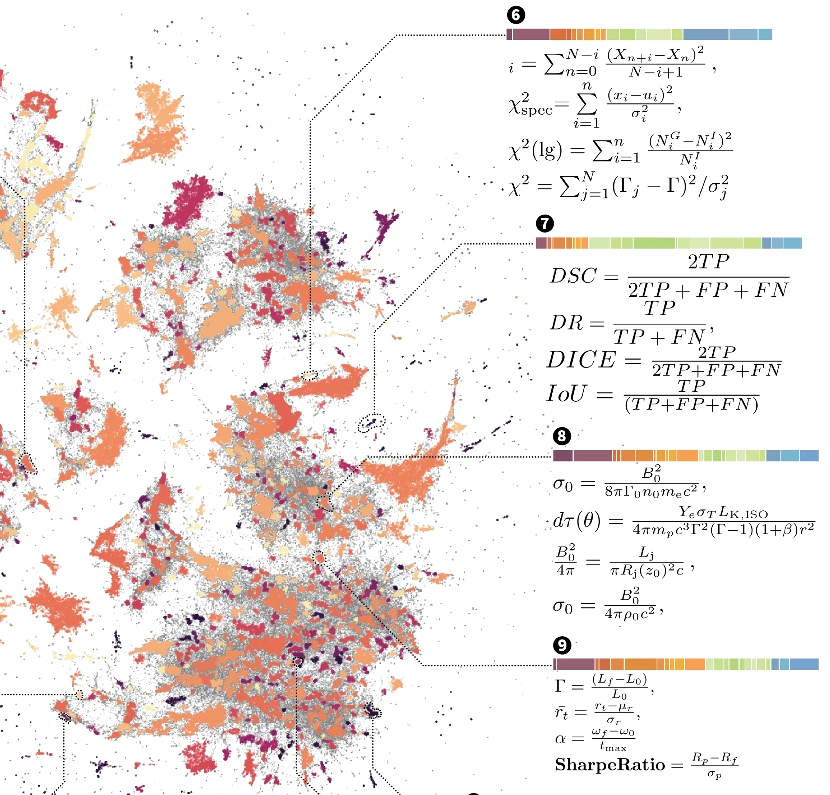
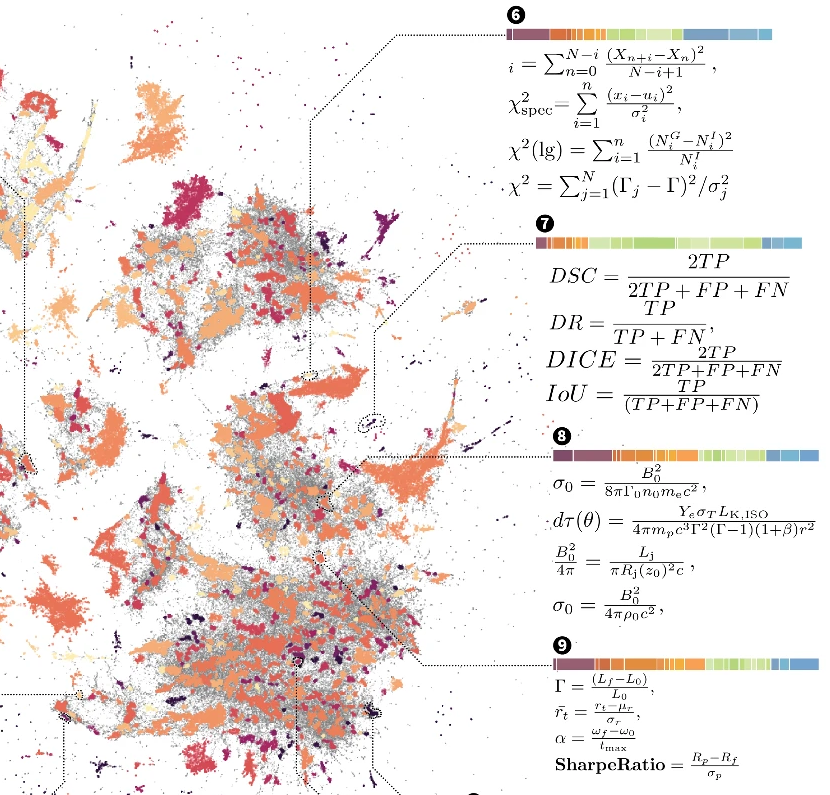
A commonly held background assumption about the sciences is that they connect along borders characterized by ontological or explanatory relationships, usually given in the order of mathematics, physics, chemistry, biology, psychology, and the social sciences. Interdisciplinary work, in this picture, arises in the connecting regions of adjacent disciplines. Philosophical research into interdisciplinary model transfer has increasingly complicated this picture by highlighting additional connections orthogonal to it. But most of these works have been done through case studies, which due to their strong focus struggle to provide foundations for claims about large-scale relations between multiple scientific disciplines. As a supplement, in this contribution, we propose to philosophers of science the use of modern science mapping techniques to trace connections between modeling techniques in large literature samples. We explain in detail how these techniques work, and apply them to a large, contemporary, and multidisciplinary data set (n=383.961 articles). Through the comparison of textual to mathematical representations, we suggest formulaic structures that are particularly common among different disciplines and produce first results indicating the general strength and commonality of such relationships.
@article{noichlHowLocalizedAre2023a,title={How Localized Are Computational Templates? {{A}} Machine Learning Approach},shorttitle={How Localized Are Computational Templates?},author={Noichl, Maximilian},year={2023},month=mar,journal={Synthese},volume={201},number={3},pages={107},issn={1573-0964},doi={10.1007/s11229-023-04057-x},urldate={2024-05-30},langid={english},}
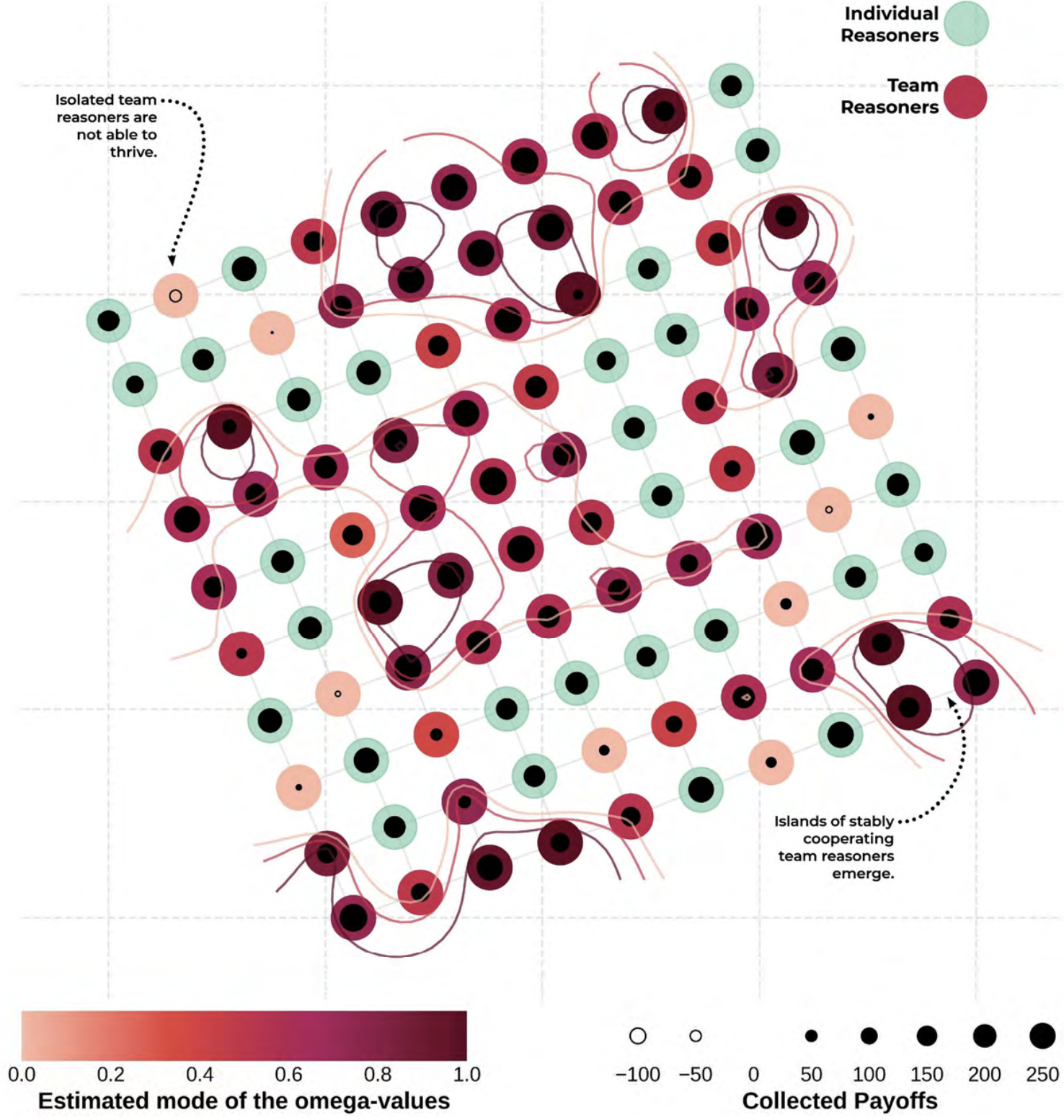
This paper presents an approach of unsupervised learning of clusters from a citation database, and applies it to a large corpus of articles in philosophy to give an account of the structure of the discipline. Following a list of journals from the PhilPapers-archive, 68,152 records were downloaded from the Reuters Web of Science-Database. Their citation data was processed using dimensionality reduction and clustering. The resulting clusters were identified, and the results are graphically represented. They suggest that the division of analytic and Continental philosophy in the considered timespan is overstated; that analytical, in contrast to Continental philosophy does not form a coherent group in recent philosophy; and that metaphors about the disciplinary structure should focus on the coherence and interconnectedness of a multitude of smaller and larger subfields.
@article{noichlModelingStructureRecent2021a,title={Modeling the Structure of Recent Philosophy},author={Noichl, Maximilian},year={2021},month=jun,journal={Synthese},volume={198},number={6},pages={5089--5100},issn={0039-7857, 1573-0964},doi={10.1007/s11229-019-02390-8},urldate={2024-05-30},langid={english},}


 Synthese, Mar 2023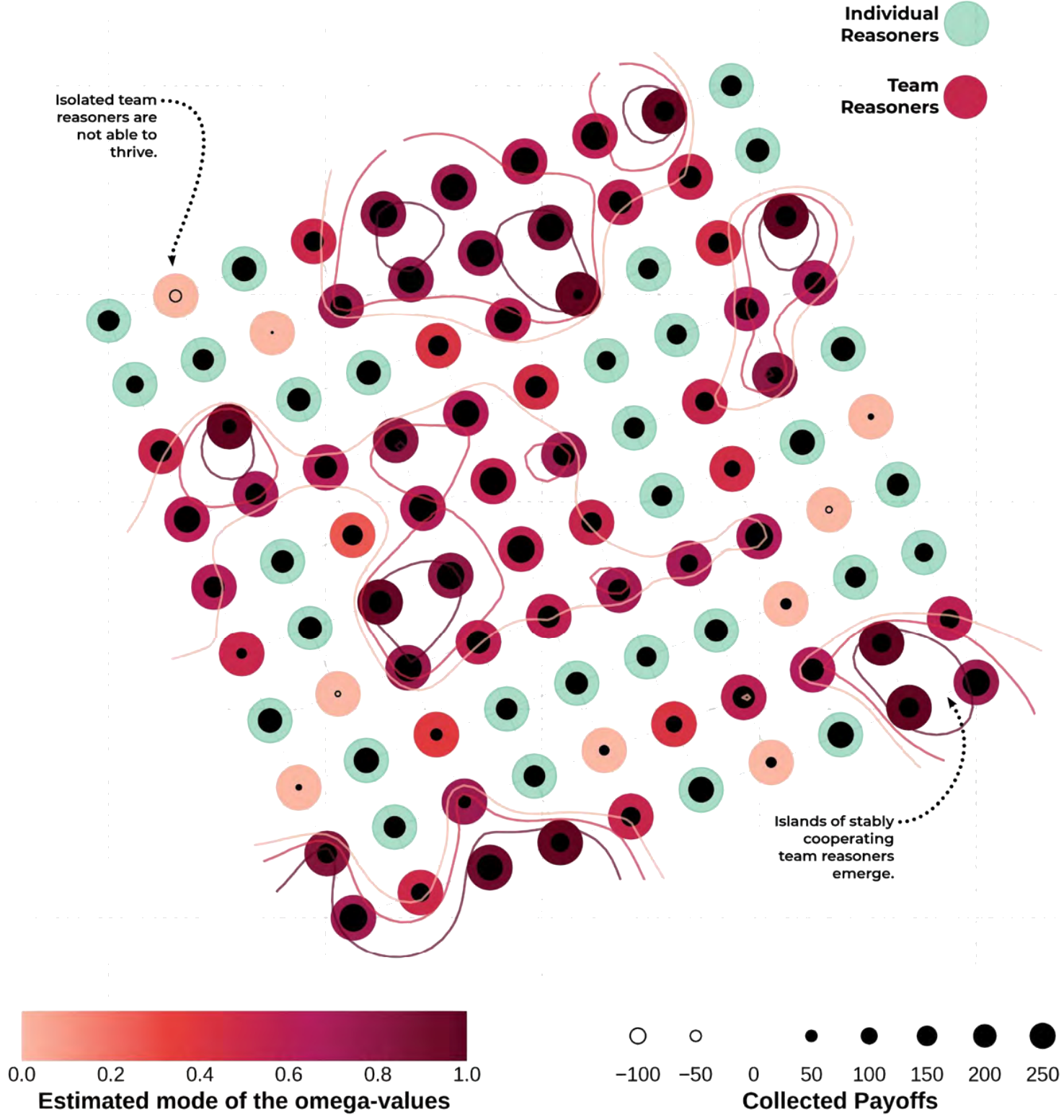
 Historical Social Research/Historische Sozialforschung, Mar 2023


